The pedagogical configuration of a virtual reality system weighs as much, if not more, than the level of immersion of the headset. A quasi-experimental study conducted with the Swiss Federal Railways (SBB) on safety training on the tracks compared six distinct formats, from desktop to multiplayer VR with perspective change.
All digital formats improved results, but the pedagogical scenario determines effectiveness more than the material. This observation underpins any serious deployment strategy in a company.
Latency, haptic feedback, and sensory fidelity: the technical parameters that condition skills transfer
We still observe too many VR projects where the choice of headset precedes the definition of the professional gesture to be trained. The system’s latency (the time between physical movement and visual response) remains a discriminating factor for gesture training. Beyond a certain threshold, the brain disconnects the sensorimotor loop, and the transfer to the real workplace collapses.
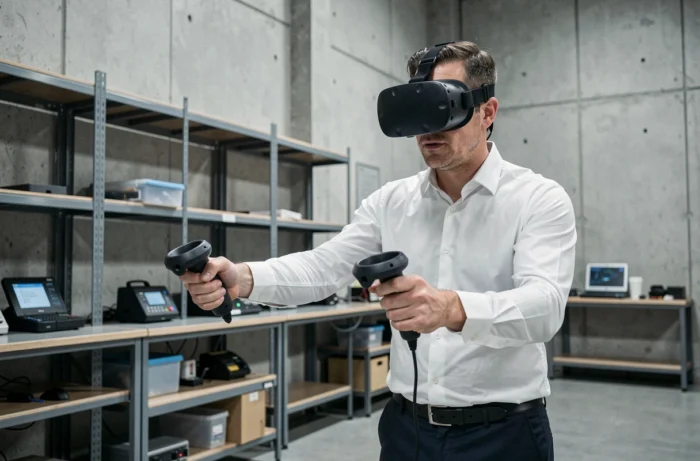
Haptic feedback poses a comparable problem. Reproducing the resistance of a tool, the torque of a torque wrench, or the texture of a technical fabric requires specialized controllers. Consumer solutions (standard controllers) are suitable for behavioral awareness but not for acquiring precision technical gestures.
The approach we recommend involves mapping the sensory channels mobilized by the target task before specifying the material. A training module for public speaking does not have the same requirements as training for orbital welding. Specialized players like immersivelab.fr structure their projects precisely around this prior analysis of the professional gesture.
Multiplayer VR scenarios and perspective change: what recent protocols reveal
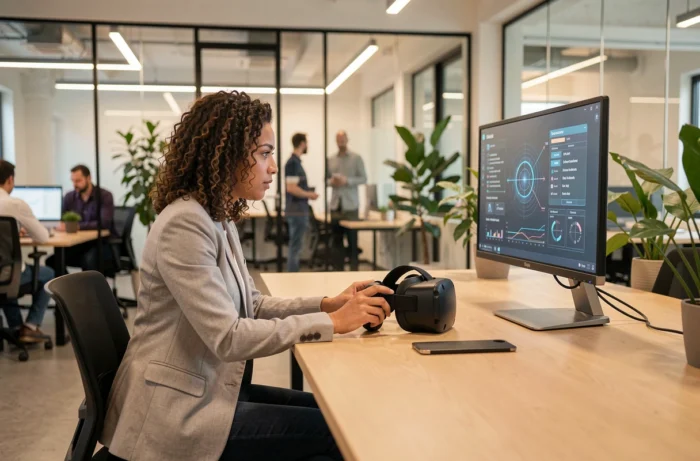
The protocols tested with the SBB show that multiplayer with perspective change outperforms individual VR on medium-term retention indicators. Allowing an operator to experience the situation from a colleague’s perspective exposed to risk permanently alters their perception of danger.
This type of system requires a stable local network infrastructure and rigorous synchronization of avatars. In industrial safety training, the delay between two participants, even of a few hundred milliseconds, breaks the illusion of co-presence and degrades the pedagogical value.
Deployment conditions in the classroom
The “classroom” VR format, where an instructor supervises several learners equipped simultaneously, introduces an additional constraint: managing motion sickness (kinetosis). We find that collective sessions impose shorter exposure durations than individual sessions, or the dropout rate increases.
- Plan sessions of fifteen to twenty minutes maximum in collective immersion, with a debriefing break between each sequence.
- Adapt the speed of movement in the virtual environment to the least tolerant profile of the group, not the average profile.
- Systematically measure the perceived presence score (post-session questionnaires) to adjust the simulation parameters from one cohort to another.
ROI of VR training: relevant indicators and measurement pitfalls
Calculating the return on investment of a VR program by limiting it to the cost per trained learner is a common mistake. The real economic lever lies in reducing post-training incidents and compressing the time needed to achieve autonomy at the job.
The recordable incident rate (OSHA recordable rate) is the most reliable indicator for safety training. Comparing this rate before and after deployment, over a sufficiently long period, provides a tangible measure that financial departments understand.
What dashboards often overlook
Most VR platforms generate tracking data (time spent, number of attempts, success rate). These metrics describe engagement in the simulator, not field performance. We recommend systematically cross-referencing VR data with actual operational indicators.
- Rejection or non-compliance rate on the production line in the weeks following training.
- Number of assistance requests at the job, which reflects the actual level of autonomy.
- Average time before the first autonomous intervention, compared to cohorts trained by traditional methods.
- Recordable incident rate over six to twelve months, not just in the post-training quarter.
XR skill frameworks and structuring immersive professions
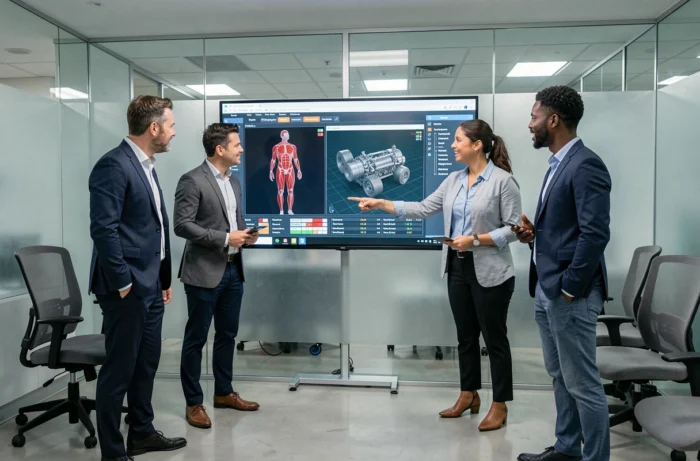
Virtual reality applied to professional training has generated its own professions. Master’s level programs in immersive experiences now prepare for RNCP level 7 titles focused on XR user experience design. This connection to national skill frameworks marks a turning point: the design of pedagogical VR systems is no longer an extension of game design; it is a discipline in its own right.
The sought-after profiles combine user research, real-time prototyping, and field pedagogical evaluation. Companies deploying VR programs without integrating this type of skill internally or through outsourced services expose themselves to technically functional but pedagogically ineffective virtual environments.
The market for VR training for frontline workers is rapidly structuring, with segmentation by sector (industry, health, logistics) and by type of targeted skill (technical gesture, safety protocol, soft skills). This sectoral specialization requires designers to master the job constraints before touching a 3D engine.
Virtual reality in training no longer suffers from a lack of evidence. It suffers from a lack of pedagogical engineering. Organizations treating the VR headset as an enhanced PowerPoint projector miss the real contribution: the ability to repeat a critical gesture under controlled, measurable, and reproducible conditions, with a level of personalization unattainable in a classroom.