
The market for eco-friendly interior decoration is no longer just about choosing “natural” shades or a few plants placed on a shelf. In recent years, European regulations and health requirements have redefined what it really means to transform your interior in an ecological way. With new standards on formaldehyde emissions, mandatory labeling of materials, and the rise of upcycling, the benchmarks are changing for those who want a stylish and healthy interior.
Formaldehyde in furniture: what the European REACH regulation entry 77 changes
The regulation (EU) 2023/1464 has added formaldehyde to Annex XVII of REACH (entry 77) since July 14, 2023. The emission limit values for furniture and wooden articles will become mandatory throughout the European Union starting from August 6, 2026. Specifically, a wood-based piece of furniture must not exceed 0.062 mg/m³ of formaldehyde under standardized test conditions.
This constraint pushes manufacturers to rethink their glues, panels, varnishes, and finishing processes towards low VOC formulations. For an individual looking to transform their interior, this means that choosing a new piece of furniture from this date offers enhanced health guarantees, provided compliance with the regulation is verified. Second-hand furniture or items made before this deadline are not subject to this limit.
On the home section of 42 Le Mag, several articles detail the criteria to watch for when purchasing furniture for a healthier interior.
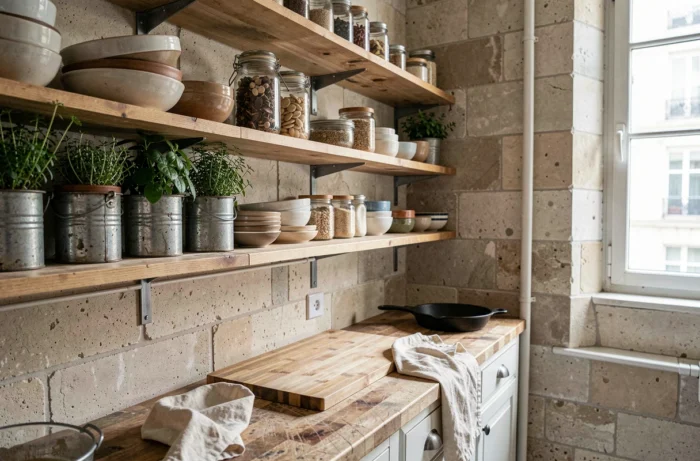
Indoor air emissions label: read the A+ rating before choosing paint and coatings
In France, a mandatory label classifies construction and decoration products according to their emissions of volatile organic compounds, from A+ (very low emissions) to C (high emissions). It covers a wide range: paints, varnishes, glues, wall coverings, panels, doors, windows, and insulation products.
To transform a room, the instinct is to check this label before any purchase of paint or flooring. A product rated A+ does not eliminate all emissions, but it significantly reduces exposure to indoor pollutants.
Field reports vary on this point: some craftsmen report that A+ rated products based on synthetic resins can still emit persistent odors upon application. Clay or lime-based paints, sometimes rated A or A+, tend to be more odor-neutral once dry.
Criteria to check on the label
- The A+ rating guarantees the lowest emission level but does not inform about the bio-sourced origin of the ingredients
- The mention “low VOC” on a paint pot remains a marketing argument: regulations set thresholds, not a total absence
- Soft floor coverings (vinyl, linoleum) also carry this label, allowing for an objective comparison of two options for the same room
Upcycling and the second life of furniture: a concrete lever to reduce the impact of decoration
Upcycling involves transforming an existing object or piece of furniture to give it a new function or renewed aesthetics, without going through the industrial recycling cycle. A sanded and repainted 1970s sideboard with A+ rated paint becomes a contemporary storage unit. An old door can be repurposed as a tabletop.
Upcycling avoids the production of a new object and the associated emissions. However, it requires mastering the finishing products used during the transformation. Applying a highly emitting polyurethane varnish on a thrifted piece of furniture negates some of the ecological benefits.
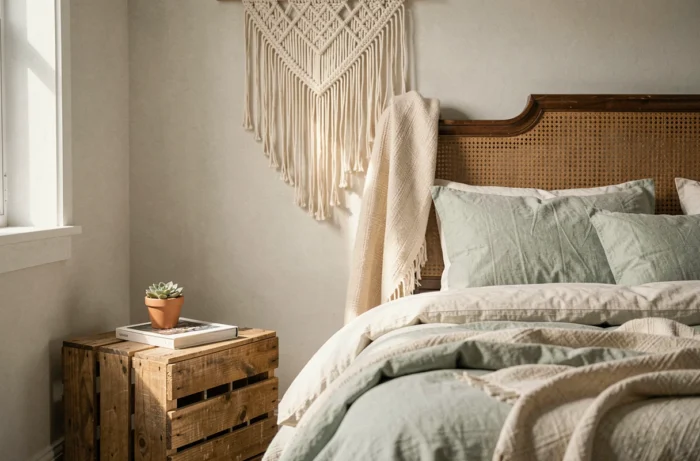
Points of caution for truly eco-friendly upcycling
- Check that the original furniture does not contain lead paint (common on furniture made before the 1950s)
- Use A+ rated paints and varnishes or natural finishes (linseed oil, beeswax) for restoration
- Prefer reused hardware or handles made from durable materials rather than low-quality new imports
- Sand outdoors or in a very ventilated space to limit inhalation of dust, especially on old coatings
The second-hand market for furniture and decorative objects has grown significantly in recent years. The available data does not allow for precise quantification of the share of refurbished furniture in French households’ decor purchases, but the proliferation of specialized platforms and makeover workshops attests to this trend.
Indoor air quality and ventilation: the often-overlooked link in an eco-friendly interior
Transforming your interior with low VOC materials loses some of its effectiveness if the ventilation of the home is insufficient. A well-functioning mechanical ventilation system renews the air and removes residual pollutants, including those emitted by products that comply with standards.
After painting or installing flooring, intensive airing for several days remains the simplest action to lower VOC concentration in the room. This point is often underestimated in guides to eco-friendly decoration, which focus on material selection without addressing the post-installation phase.
Eco-friendly interior design is not limited to selecting beautiful labeled objects. It incorporates ventilation, long-term emission management, and consistency among the materials used in the same room. A stylish and healthy space relies as much on what is not visible (air quality, panel glues, paint ratings) as on the thrifted piece of furniture that catches the eye.