
The load index marked on the sidewall of a tire determines the maximum weight it can support at full speed. Between a 91V tire and a 94V tire, the difference may seem small, but it alters the safety margin under load and can render a vehicle non-compliant during technical inspection. This article lays out the data side by side to identify what really changes between these two indices.
Load capacity 91V and 94V: comparison table
| Characteristic | Tire 91V | Tire 94V |
|---|---|---|
| Load index | 91 | 94 |
| Maximum load per tire | 615 kg | 670 kg |
| Total load on 4 tires | 2,460 kg | 2,680 kg |
| Speed index (V) | Up to 240 km/h | Up to 240 km/h |
| Frequent XL marking | No | Yes (reinforced structure) |
The letter V remains the same in both cases and allows a maximum speed of 240 km/h. The difference lies exclusively in the number that precedes it. The gap of 55 kg per tire between index 91 and index 94 represents an additional 220 kg margin across the entire axle.
Before comparing a 91V or 94V tire, it is essential to note the minimum index recorded in the maintenance booklet or on the label affixed to the driver’s door frame. This baseline value determines the compliance of the installation.
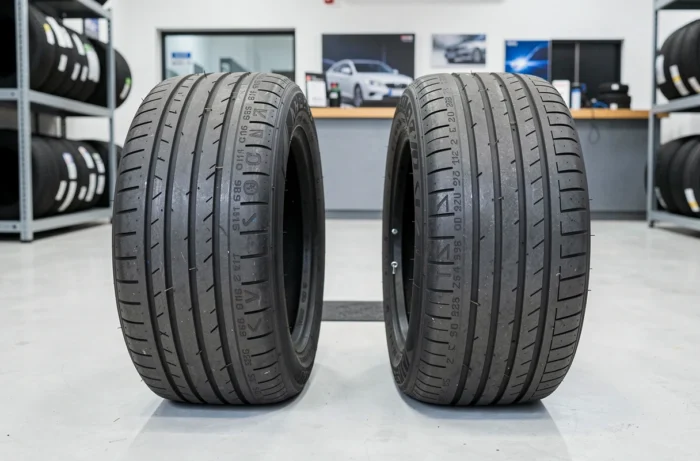
Load index below manufacturer recommendations: real risks
Fitting a higher load index than recommended is always allowed. However, a lower index is grounds for a re-inspection during technical control. If the manufacturer prescribes a 94 index, a 91V tire will not pass the inspection, even if the dimensions (width, height, diameter) are identical.
The consequences do not stop at technical control. A tire used beyond its load capacity heats up more, which accelerates tread wear and increases the risk of blowout at high speed. On the highway, the margin between the actual load and the maximum load of the tire quickly decreases when the vehicle carries passengers and luggage.
Insurance and liability in case of an accident
An insurer may invoke the non-compliance of tires to reduce or deny compensation after an accident. This point is rarely mentioned in buying guides, but it constitutes a real contractual lever. Checking the load index before installation avoids this type of dispute.
Tire 94V and XL marking: what the reinforced structure changes
A 94V tire often bears the XL (Extra Load) marking on its sidewall. This marking indicates a reinforced internal construction, with additional layers or a stiffer casing, designed to withstand a higher inflation pressure.
- The recommended service pressure is generally 0.2 to 0.4 bar higher than that of a standard tire of the same size, which alters the vehicle’s behavior in curves and during braking.
- The ride comfort may be slightly firmer due to the increased rigidity of the sidewall, a parameter noticeable on small road irregularities.
- Wear resistance tends to be better under heavy load, as the structure is designed to support a greater weight without excessive deformation.
Under-inflating an XL tire negates part of its advantage. The pressure recommended by the manufacturer for an XL fitting is indicated on the vehicle label or in the technical manual. Ignoring it means reducing the effective load capacity below the displayed index.
Montagne Law and choice between 91V and 94V: an additional criterion
Since November 1, 2024, the Montagne II Law requires the 3PMSF marking (mountain and snowflake pictogram) to circulate in compliance in the 34 affected departments between November and March. The simple M+S marking is no longer sufficient.
For drivers who are hesitating between 91V and 94V in a winter or mountainous context, the load index is only part of the equation. The chosen model must also bear the 3PMSF symbol, which restricts the available catalog. Some references in 94V XL are not available in a 3PMSF homologated winter version, and vice versa.

Verification before purchase in mountainous areas
- Confirm that the load index is equal to or greater than the manufacturer’s recommendation.
- Check for the presence of the 3PMSF marking on the sidewall if the vehicle operates in a department subject to the Montagne Law.
- Check the recommended inflation pressure for an XL fitting, which is often different from that of a standard tire.
- Compare the price in relation to availability: a 94V XL 3PMSF generally costs more than a standard summer 91V.
Which load index to choose according to the type of vehicle
A light vehicle such as a compact sedan, whose total authorized weight remains moderate, works very well with a 91V index if it is the original recommendation. Fitting a 94V on this type of car does not provide a measurable safety gain but poses no compatibility issues.
For SUVs, minivans, or station wagons regularly loaded (large family, trailer, professional equipment), the 94V index offers a more comfortable safety margin. The difference of 220 kg across four tires roughly corresponds to the weight of two adult passengers with their luggage.
The decision criterion remains simple: never go below the index prescribed by the manufacturer. Fitting a higher index is possible, by checking pressure compatibility and accepting a slight extra cost. This choice is particularly justified when the vehicle frequently operates at full load or tows a trailer.