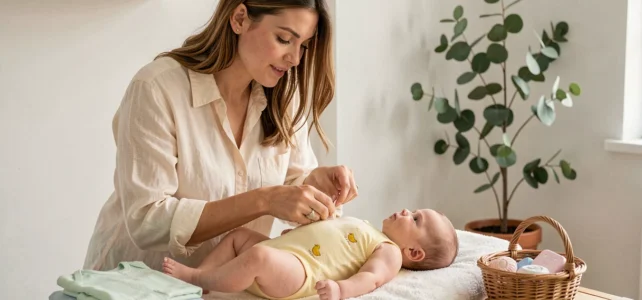
Dressing a baby daily raises a seemingly simple question: how to combine softness on the skin, freedom of movement, and a minimum of style? The answer lies less in the number of pieces in the drawer than in a few well-thought-out choices of materials, cuts, and closures. Here are the concrete guidelines that truly enhance your baby’s comfort, from the morning bodysuit to the evening pajamas.
Baby clothing labels and textiles: what to check before buying
Before looking at the color or pattern, turn the garment inside out. The composition label is the first useful filter. A bodysuit with a high proportion of polyester is likely to make your baby sweat, especially in summer.
Cotton remains the reference fiber for baby clothes: natural, soft, and hypoallergenic, it absorbs moisture well and limits irritation. Certified organic cotton (GOTS or Oeko-Tex Standard 100 label) goes further by ensuring the absence of problematic chemical residues like formaldehyde or certain azo dyes. For skin prone to eczema, fibers like bamboo or Tencel regulate moisture better than regular cotton and reduce friction.
On the safety side, the European standard EN 14682 strictly regulates cords and ties on children’s clothing. Check that no loose cord protrudes at the neck or hood: this is a documented strangulation risk.
Since December 2024, the European regulation GPSR (2023/988) strengthens traceability and labeling obligations for all products sold in the EU, including baby clothes. Complete labeling (composition, origin, EU responsible party) is now mandatory.
Parents looking for brands attentive to these criteria will find a pre-filtered selection on the Les Bébés Fringueurs website, featuring pieces designed for the daily lives of little ones.
Baby-friendly cuts and closures: saving time at every change
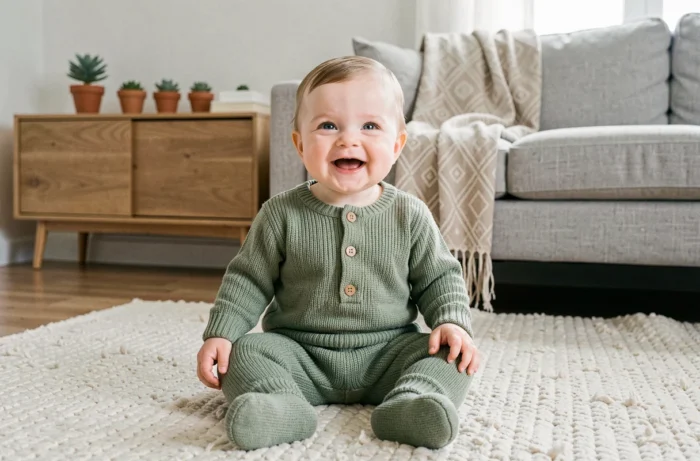
Have you ever tried to put a crew-neck sweater on a wiggly newborn? The result is rarely pleasant for either the baby or the parent. The cut of a garment is just as important as its material.
Front closures simplify every dressing. For the first few months, opt for crossover bodysuits (called “wrap”) that can be put on without going over the head. Snap buttons at the crotch speed up diaper changes. Zippers are ideal for pajamas and rompers, provided a fabric flap protects the baby’s skin from contact with the metal.
Here are some cut guidelines to keep in mind:
- American necklines (crossed at the shoulders) allow the garment to be pulled up from the bottom if the top is soiled, preventing a dirty bodysuit from sliding across the baby’s face.
- Raglan sleeves offer more room at the shoulders and facilitate arm movements, especially when the baby starts to crawl.
- Integrated feet on pajamas eliminate the need for socks (which are always getting lost), but check that non-slip grips are included from size 9-12 months.
Another often overlooked point: going one size up is almost always the best choice. A slightly loose garment does not restrict, while a too-tight garment compresses the thighs at the diaper area and leaves marks on the skin. Babies grow in bursts; a snug bodysuit today will be too small in two weeks.
Dressing baby in style without sacrificing comfort daily
Combining style and comfort for a baby does not require a XXL wardrobe. Three principles are enough to create outfits that work well at the park as well as during visits to grandparents.
The modular layering system
Layering remains the most effective method to adapt to temperature variations throughout the day. A cotton bodysuit as a base, a long or short-sleeved top depending on the season, and an outer layer that is easy to remove (cardigan, zip-up sweater). This trio covers most situations without cluttering the diaper bag.
In winter, merino wool works remarkably well as an intermediate layer. It regulates body temperature, stays warm even when wet, and does not itch if the weave is fine. In summer, a simple short-sleeved cotton bodysuit is often sufficient indoors.
Colors and combinations without hassle
Why do some baby wardrobes work better than others? Because the pieces are designed to combine with each other. Choosing a limited palette of three or four shades (ecru, beige, terracotta, and denim blue, for example) allows any bottom to be paired with any top.
Subtle prints on neutral backgrounds age better than bold patterns and facilitate resale or hand-me-downs. Solid colors for basic pieces, patterns for accessories or outer layers: this logic simplifies rushed mornings.

Baby clothing care: preserving softness wash after wash
A well-chosen garment can lose all its qualities after a few poorly managed washes. Babies’ skin reacts to both detergent residue and the fiber itself.
- Wash new clothes before first use to remove textile finishes (substances added in factories to give a smooth appearance in stores).
- Use a detergent that is fragrance-free and free of harsh enzymes. Not all hypoallergenic labeled detergents are truly so: check for the absence of methylisothiazolinone, a common allergenic preservative.
- Prefer air drying. The dryer weakens cotton fibers and can shrink clothes by half a size in just a few cycles.
- Conventional fabric softeners leave a film on fibers that reduces their absorbency. A splash of white vinegar in the rinse compartment softens without residue.
These precautions do not take more time than a standard routine. They extend the lifespan of the pieces and maintain the textile comfort you initially paid for.
Dressing a baby in style and comfort daily ultimately relies on verified material choices, practical closures, and a wardrobe focused on combinable pieces. The most useful garment is not the prettiest in photos; it is the one your baby wears without needing to be changed three times before noon.