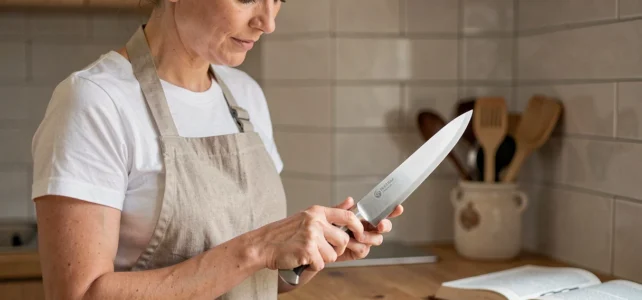
A failed dish rarely stems from a lack of talent. The problem often comes from a pan that sticks, a knife that crushes instead of slicing, or a pot with a bottom that poorly distributes heat. Choosing the right kitchen equipment lays the foundation for regular and successful meals, without multiplying unnecessary gadgets.
Materials of kitchen utensils: how the coating changes what’s on the plate
Have you ever noticed that a sauce reduces differently depending on the pot used? It’s not just an impression. The material of the container alters the heat distribution, the responsiveness to temperature changes, and the behavior of the food on the surface.
Stainless steel remains the most versatile material for pots and Dutch ovens. It does not react when in contact with acids (tomatoes, wine, lemon), is easy to clean, and lasts for decades. Its limitation: it conducts heat poorly on its own. Models with a base of encapsulated aluminum or copper correct this flaw.
Enamelled cast iron excels for long cooking and stews. Its significant mass stores heat and releases it evenly, even on low heat. It is heavy, making it less practical for daily use, but for braising or homemade bread, nothing can replace it.
To explore the equipment offered by Gourmandel, you will find ranges that prioritize these durable materials, suitable for different budgets.
When it comes to frying pans, the issue of non-stick coatings deserves particular attention. The European regulation on PFAS is tightening since 2026, with restrictions on fluorinated substances in materials that come into contact with food. Ceramic, cast iron, or brushed stainless steel pans are gaining ground as reliable alternatives, free from controversial compounds.

Kitchen knives: three blades are enough to cut everything
Blocks of twelve knives impress in a display. In practice, three well-sharpened blades cover almost all tasks in the kitchen.
- The chef’s knife (or chef’s knife), with a blade of about twenty centimeters, is used for chopping, slicing, and dicing herbs and cutting vegetables. This is the blade you will use most often.
- The paring knife, smaller, allows for precision tasks: peeling a fruit, removing a potato eye, dicing shallots.
- The bread knife, with its serrated blade, slices both a crusty loaf and a ripe tomato without crushing it.
A knife that cuts well reduces the risk of injury. Accidents happen when the blade resists, when you force it, and when you slip. Investing in quality steel and maintaining the edge with a honing rod or sharpening stone radically changes the comfort of work.
European steel or Japanese knife
Japanese knives are appealing for their exceptional sharpness and the finesse of their blades. They are perfectly suited for delicate cuts of vegetables and fish. Their steel, often harder, retains the edge longer but is more brittle in case of twisting.
Classic European knives offer a thicker blade, more tolerant of abrupt movements and bones. The choice depends on your habits: if you cook a lot of vegetables with precise movements, a Japanese blade makes sense. For versatile use including meats and squashes, a European chef’s knife is more suitable.
Cooking equipment: frying pan, sauté pan, and Dutch oven to cover all dishes
A complete cookware set does not mean owning ten pieces. Three well-chosen containers allow you to prepare the majority of everyday recipes.
The frying pan, of medium diameter, handles high-heat cooking: searing a piece of meat, sautéing vegetables, cooking an omelet. Opt for a thick base for even heat and to avoid hot spots that burn food in places.
The sauté pan combines the advantages of the frying pan and the pot. Its high sides allow for searing and then deglazing, adding liquid, and simmering without changing containers. It is the most underestimated format in home cooking.
The Dutch oven or casserole takes over for soups, pasta, broths, and long cooking. Made of cast iron or thick stainless steel, it can handle both the stovetop and the oven.
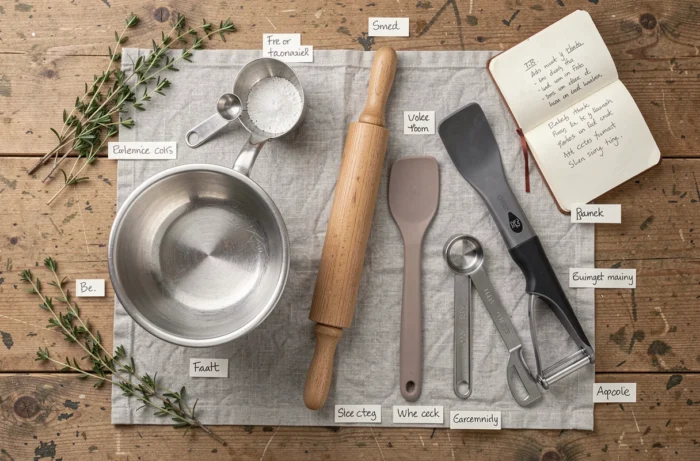
Compatibility with cooktops
On an induction cooktop, only containers with a ferromagnetic base work. Stainless steel, cast iron, and steel are compatible. Pure aluminum and copper are not, unless with an adapter disc or a specific base. Check the spiral pictogram under your utensils before investing.
Choosing kitchen utensils without cluttering your drawers
Beyond knives and containers, a few simple tools make a difference in daily life. A solid wood cutting board absorbs shocks and preserves the edge of the blades better than glass or hard plastic. A wooden or silicone spatula protects cooking surfaces. A kitchen thermometer clarifies the cooking of thick meat or caramel.
The mandoline speeds up the regular cutting of vegetables, from cucumber slices to carrot juliennes. Choose a stable model with an integrated finger guard, as the blade is remarkably effective.
Regarding food-grade silicone, molds and spatulas of this type remain practical, but check the product’s compliance with European food standards. Controls are tightening on potential contamination with fluorinated compounds, including on materials considered safe until recently.
Resist the urge to buy a utensil for every recipe. A good basic set, maintained and suited to your cooking habits, makes each preparation step smoother. It’s better to have three quality tools that are used every day than a drawer full of accessories used once a year.