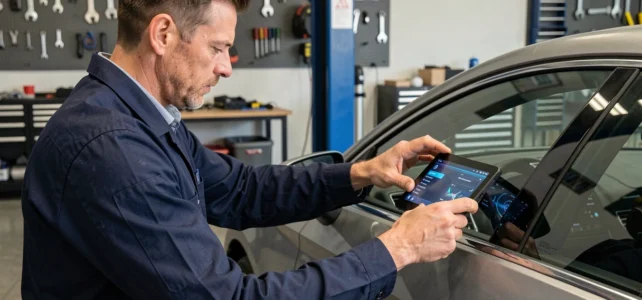
Which embedded technologies have truly changed the driving experience in 2024? Between new European regulatory requirements, biometric sensors, and heads-up displays framed by international standards, the gap widens between gadget innovations and those that redefine safety or driver-vehicle interaction. This article compares the most significant advancements that emerged this year in the automotive industry.
Comparison of Notable High-Tech Automotive Innovations in 2024
Not all new features have the same level of maturity or impact on daily driving. The table below contrasts technologies based on their domain, actual availability, and the regulatory framework that accompanies them.
| Innovation | Domain | Availability in 2024 | Regulatory Framework |
|---|---|---|---|
| Augmented Reality Heads-Up Display (HUD) | Driver Interface | Premium segments, gradual deployment | UN R125 (effective Sept. 2023), R17X project at WP.29 |
| Driver Monitoring Camera (DMS) | Active Safety | Mandatory on new EU-approved models starting July 2024 | EU GSR2 Regulation |
| Biometric Sensors (heart rate, fatigue) | Safety / Well-being | Prototypes and some high-end models | No specific standard yet |
| Over-the-Air Software Updates (OTA) | Connectivity | Wide distribution, including mid-range segments | UN R156 (UNECE) |
| Embedded LiDAR for ADAS | Semi-Autonomous Driving | Premium models and Chinese manufacturers | Existing ADAS standards, no dedicated LiDAR framework |
This overview shows that European regulation accelerates the adoption of certain technologies much more than manufacturers’ marketing efforts. Driver monitoring systems (DMS) and regulated HUDs illustrate this dynamic.
Automotive enthusiasts can find detailed guides on Auto High-Tech to follow these developments over the months.
Driver Monitoring by Camera: What the GSR2 Regulation Really Imposes
Since July 2024, the European General Safety Regulation 2 (GSR2) mandates a driver monitoring system by camera on all new models approved in the European Union. The system analyzes in real-time the direction of gaze, blink rate, and head position to detect drowsiness or distraction.
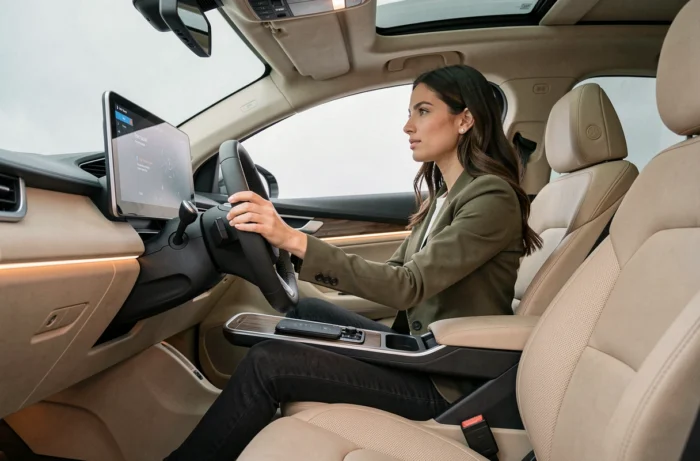
In practice, the camera is usually integrated into the steering column or the upper dashboard. If the system detects prolonged inattention, it triggers an audible and visual alert. If there is no reaction, some vehicles activate gradual braking until a complete stop.
This requirement raises questions about the management of biometric data. The regulation specifies that images must not be stored or transmitted outside the vehicle. However, manufacturers sometimes integrate these streams into broader connected systems, creating a gray area regarding privacy protection.
DMS and Biometric Sensors: The Boundary Becomes Blurred
Some equipment manufacturers go beyond simple fatigue detection. Prototypes integrate sensors capable of measuring the driver’s heart rate via an infrared camera, without physical contact. Automotive biosensing remains experimental, but it represents the next logical step after mandatory DMS.
The difference between a regulatory DMS and an advanced biometric system lies in the nature of the data collected. The former is limited to posture and gaze. The latter analyzes physiological parameters, placing it within a stricter legal framework, particularly concerning GDPR.
Heads-Up Display and Augmented Reality: The Standards Governing Automotive HUDs
Heads-up displays (HUDs) projecting information directly onto the windshield have existed for several years in the premium segment. What changes in 2024 is the international regulatory framework for these devices.
The global WP.29 forum of the United Nations Economic Commission for Europe (UNECE) has incorporated HUDs into the regulated category of “auxiliary vision” through regulation UN R125, which came into effect on September 1, 2023. A complementary project, regulation R17X on front visual assistance systems (FVA), was presented to WP.29 in 2024.
This project imposes specific constraints:
- The driver’s main field of vision is divided into zone 1 and zone 2, with different rules on what can be displayed there
- The opaque pixel rate in the field of vision is limited to avoid obstructing the road
- The driver must be able to adjust the brightness and turn off the HUD in a maximum of two actions
In China, a national standard (GB/T 46926-2025) on auxiliary vision systems for light vehicles was published at the end of 2025 and is set to apply from July 2026. The Chinese market and the European market are converging towards similar requirements, prompting manufacturers to design HUDs compliant with both frameworks.
OTA Updates and Connected Vehicles: What Manufacturers Modify Remotely
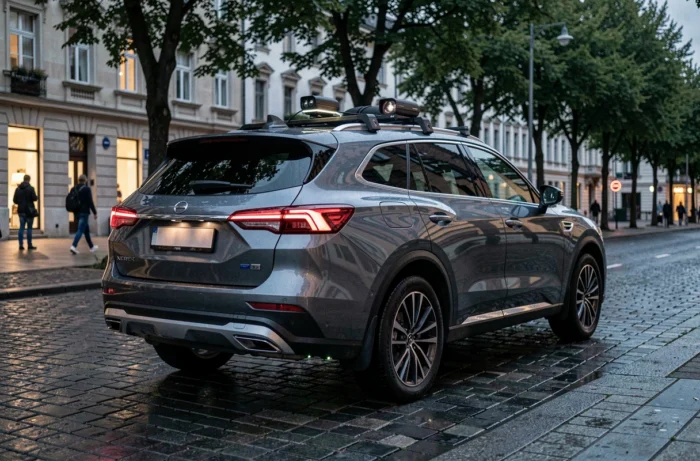
Over-the-air (OTA) software updates allow manufacturers to fix bugs, improve powertrain performance, or add features without visiting a dealership. This practice, regulated by UNECE UN R156, has become widespread well beyond just electric vehicles.
The notable change in 2024 concerns the nature of the updates. They are no longer just security patches. Several manufacturers now offer paid features that can be activated remotely: heated seats, additional engine power, advanced parking assistance. The vehicle becomes a subscription service platform.
This evolution divides consumers. On one hand, the ability to add functions after purchase offers unprecedented flexibility. On the other hand, paying to unlock equipment physically present in the vehicle is causing growing resistance, particularly in European markets.
- Security updates remain free and mandatory according to UN R156
- Paid features activated remotely vary significantly from one manufacturer to another
- The question of the vehicle’s residual value at resale arises when options are linked to a personal subscription
The regulatory framework clearly distinguishes between updates affecting safety (subject to approval) and those related to comfort or entertainment. This distinction remains the anchor point for consumers who want to understand what the manufacturer can, or cannot, modify on their vehicle without explicit consent.
The year 2024 will have shown that the most significant automotive innovations are not necessarily those that make the most media noise. The mandatory DMS camera and the regulation of HUDs are reshaping the relationship between driver, vehicle, and regulator, with lasting consequences for cabin design and personal data management.