Blind football has been part of the Paralympic program since 2004, but the question of its real accessibility for visually impaired individuals remains. Who can play it, with what level of visual impairment, and under what conditions? To answer these questions, we need to look at the data from the French Handisport Federation and recent developments in the field.
Categories of visual impairment and access to blind football: who plays where?
Blind football distinguishes several player profiles according to the international classification of visual impairment. The distribution of roles on the field directly depends on this classification, which concretely determines who can play and in what position.
| Category | Level of vision | Authorized role in competition | Leisure practice |
|---|---|---|---|
| B1 | Blind or light perception without form | Field player (headband required) | Yes |
| B2 | Partially sighted (very reduced acuity) | Goalkeeper only (Paralympic Games) | Yes |
| B3 | Partially sighted (moderate acuity) | Goalkeeper only (Paralympic Games) | Yes |
| Sighted | Normal vision | Goalkeeper only | Yes (initiations) |
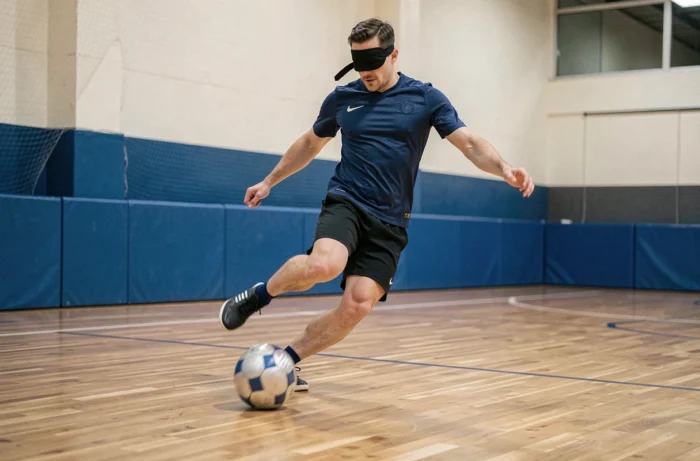
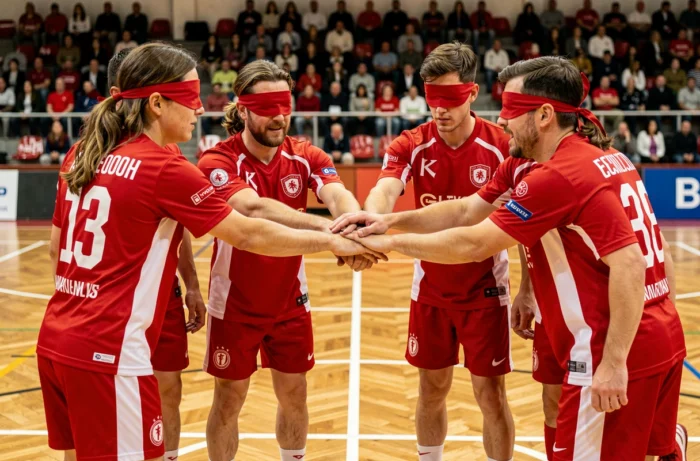
In Paralympic competition, only B1 classified players occupy field positions. Categories B2 and B3 are only allowed in the goalkeeper position. This rule ensures strict equality among field players, all wearing an opaque headband regardless of their visual residue.
On the other hand, leisure practice opens the doors to all categories of visual impairment. Several handisport clubs welcome B2 or B3 visually impaired individuals as field players during non-competitive sessions. The possibility of practicing blind football with partial visual impairment is thus confirmed in practice, even though the regulatory framework for competition remains more restrictive.
Licensed players and structures in France: the figures from the Handisport Federation
The data from the French Handisport Federation allows us to measure the reality of practice beyond the Paralympic Games.
- More than 500 licensed players in blind football and futsal for visually impaired individuals at the national level
- 289 competitors engaged in official championships
- 51 licensed players registered in leisure practice
- 97 establishments involved in supervision or hosting
- 62 registered associative structures
The ratio between competitors and leisure licensees draws attention: competitive practice largely dominates. This reflects a history of structuring blind football around performance, inherited from its integration into the Athens Paralympic Games in 2004.
An imbalance between competition and leisure
With only 51 declared leisure licensees, blind football remains a sport where structured discovery outside of competition remains marginal in the federal statistics. This figure does not reflect all the individuals who have tried blind football during occasional initiations, but it indicates a deficit of regular practice for those who do not aim for competition.
The gap is partly explained by the lack of suitable infrastructure. A blind football field requires lateral barriers of about 1.20 meters, a space of 40 x 20 meters, and a controlled sound environment. Few municipalities have a dedicated permanent field.
Mobile blind football sessions: a game-changing model
Since 2024, French associations have developed a format of free and mobile sessions, specifically aimed at visually impaired individuals in municipalities lacking specialized fields. This mobile model transforms the question of accessibility.
These sessions operate with facilitators trained in the specifics of visual impairment. Communication materials are systematically adapted: audio formats, documents in large print, information accessible via screen readers. The stated goal is discovery, not competition.
The impact of the Paris 2024 Paralympic Games
The French blind football team won the title of Paralympic champion at home during the Paris 2024 Games. This victory has led to an influx of inquiries to pioneering clubs. Visually impaired individuals from entire urban areas have contacted organizations to join teams or participate in initiation sessions.
Technical adaptations of blind football: what makes practice possible
Blind football relies on a set of sound and tactile adaptations without which practice would be impossible. These adaptations constitute the technical foundation that allows players without vision to orient themselves, anticipate, and play collectively.
The ball contains bells that emit a continuous sound when rolling. The lateral barriers serve both as spatial reference and tactical element, with rebounds being an integral part of the game. The field does not have touchlines, and the game almost never stops.
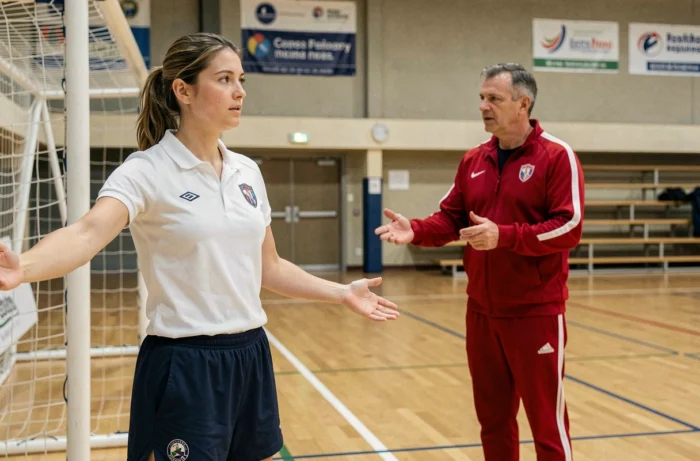
Three vocal guides support each team: the goalkeeper (sighted) directs the defense, a guide positioned behind the opposing goal directs the attackers, and the coach covers the midfield. The announcement “voy” (from the Spanish verb meaning “I’m going”) is mandatory for any player moving towards the ball carrier to avoid collisions.
Skills developed through practice
Blind football engages skills rarely utilized in other adapted sports:
- Spatial orientation in a dynamic environment, without visual reference
- Fine auditory perception to locate the ball and teammates
- Collective strategy relying entirely on vocal communication
- Sustained cardiovascular endurance throughout the match
The practice of blind football for visually impaired individuals is neither a myth nor a sport reserved for a Paralympic elite. Federal data shows a real base of licensed players, mobile sessions eliminate geographical barriers, and leisure clubs are beginning to structure themselves. The main obstacle remains the limited number of regular hosting structures, a gap that the momentum following the Paris 2024 Games is gradually helping to reduce.