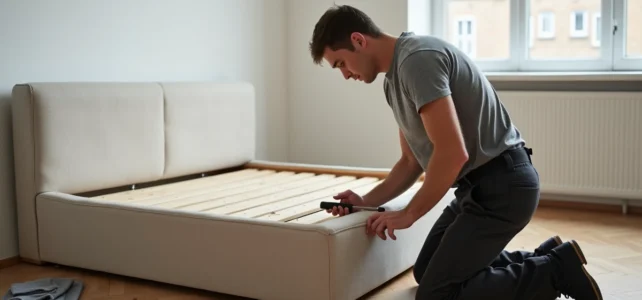
A box spring is a rigid frame (wood or metal) whose slats or springs are covered with a stretched fabric, often secured with industrial staples. This textile covering complicates disassembly compared to a slatted base, because it must first be removed without damaging the frame. Knowing the order of intervention helps avoid breaking a crossbar or bending a metal piece that cannot be replaced.
Staples, glue, or clips: identify the fabric attachment before touching the frame
The fabric of a box spring is not fixed in the same way depending on the era and the manufacturer. Older models use metal staples driven into the wood every few centimeters. More recent box springs, designed with repairability in mind, sometimes favor plastic clips or Velcro strips.
Identify the type of attachment before taking out a tool. Turn the box spring over and examine the underside of the frame: this is where the fabric is folded and secured. If you see staples, you will need a flat screwdriver or a staple remover. If the fabric is glued, the work will take longer and the risk of tearing wood fibers is higher.
This diagnostic step takes a few minutes and allows you to disassemble a box spring with Perspective Maison by choosing the right method from the start, rather than forcing blindly.
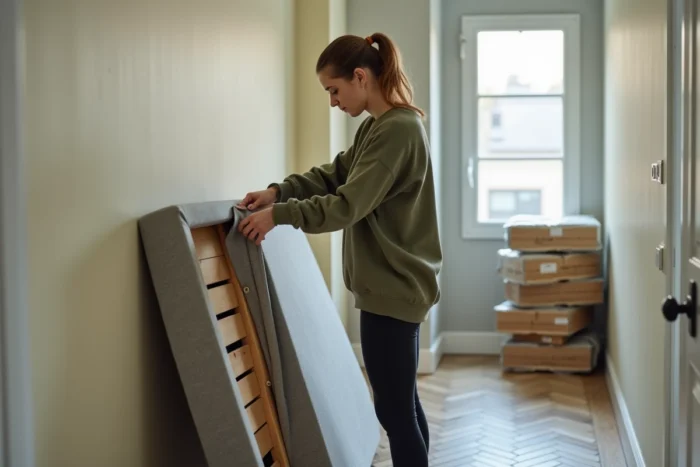
Removing the fabric from the box spring without damaging the frame
Place the box spring flat, fabric side down, on a clean surface. Working on the floor limits the risk of falling and stabilizes the structure while you work on the attachments.
Removing staples with a flat screwdriver
Slide the blade of the screwdriver under each staple and gently pry it up. Always work along the grain of the wood to avoid splintering the surface. Remove the staples one by one starting from a corner, then progress along the edge. Pull the fabric as it releases, without jerking.
Keep the fabric if it is in good condition: it can be reused during reassembly or protect the box spring during a move.
In the case of glued fabric
On some models, the fabric is glued around the frame in addition to (or instead of) the staples. A heat gun set to a low temperature softens the glue and allows the fabric to be peeled off gradually. Work in small sections to avoid overheating the wood.
Disassembling the slats and legs of the box spring
Once the fabric is removed, you gain access to the internal structure. This is where the actual disassembly begins.
Removing the slats from their supports
The slats rest on rubber or plastic ends (called end caps or sliders) clipped into the frame. To remove them:
- Lift one end of the slat and slightly twist it to unclip it from its end cap
- If the end cap resists, press down on its center with your thumb while pulling the slat upward – the clip will release without breaking
- Group the slats in pairs and number them if they have different curves, as their position influences the mattress support during reassembly
Never force a curved wooden slat: if it resists, it means the end cap is not properly disengaged. Forcing can split the slat or break the end cap.
Unscrewing the legs and separating the frame
The legs are usually unscrewed by hand or with a suitable wrench. Some models use a standard screw thread, while others have a threaded metal insert embedded in the wood. Identify the diameter before forcing with the wrong tool.
The frame itself separates at the corners, where the crossbars are bolted or interlocked. On a wooden structure, you will find long screws or through bolts. On a metal structure, hexagonal bolts require an Allen wrench or a socket wrench.
Store the screws in a labeled bag by area (left corner, central crossbar). During reassembly, a missing screw can compromise the rigidity of the whole.
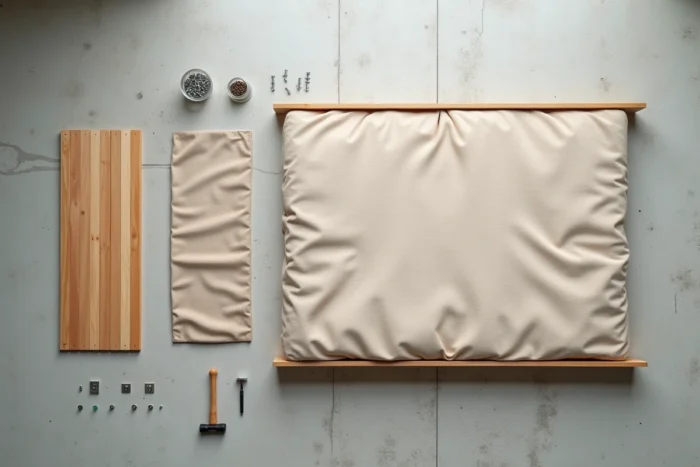
Recent box spring: a design that facilitates disassembly
The European regulation ESPR, which came into effect in July 2024, sets requirements for repairability and recyclability for furniture starting in 2028. Bedding manufacturers are already anticipating these constraints by modifying the design of their box springs.
Specifically, recent ranges favor stapled fabrics rather than glued ones and replace non-recyclable staples with removable fasteners. On these models, removing the fabric takes a few minutes instead of a tedious tearing job.
If you buy a new box spring and know that a move is likely, check the product sheet or the digital passport (when available) to see if the manufacturer mentions disassembly instructions. This is a reliable indicator of a design intended for disassembly.
Tools needed to disassemble a box spring
Here is the list of tools to gather before starting, so as not to interrupt the work halfway:
- A flat screwdriver (for staples) and a Phillips screwdriver (for the frame screws)
- An Allen wrench or a socket wrench suitable for the diameter of the bolts on your model
- A staple remover if the staples are deeply embedded in the wood
- Resealable bags and a marker for sorting screws
- Work gloves, as the removed staples are sharp
Good lighting is as useful as a good tool: many disassembly errors come from a screw that was not seen under the frame.
Before disposing of the box spring at the recycling center in case of replacement, check with the Eco-Mobilier sector if a collection point accepts disassembled box springs. Clean dismantling (wood separated from fabric and metal) facilitates sorting and recycling of materials.