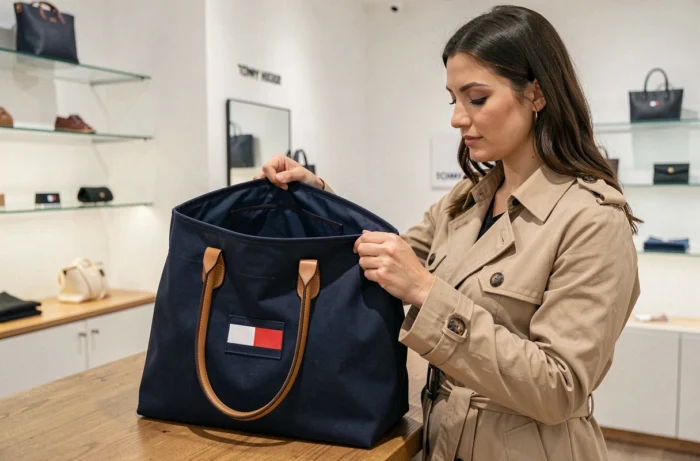
Distinguishing an authentic Tommy Hilfiger bag from a counterfeit relies on measurable criteria. Proportions of the flag logo, regularity of the stitches, consistency of the interior labels, quality of the fabric or leather: each element can be examined methodically. The stakes go beyond aesthetics, as the traceability of the purchase and legal recourse in case of a non-compliant product constitute an often-overlooked aspect.
Comparison Chart: Authentic vs. Counterfeit on Five Verifiable Criteria
Before examining each point in detail, a table summarizes the most common discrepancies between a genuine Tommy Hilfiger bag and a copy.
| Criterion | Authentic Bag | Common Counterfeit |
|---|---|---|
| Flag Logo (Proportions) | Four rectangles in a 2×2 grid, red and white of strictly identical size | Asymmetrical rectangles, red often wider than white |
| Stitches | Regular stitches, strong thread, no fraying or loose threads | Irregular stitches, thin thread that unravels, visible glue excess |
| Interior Label | Clear font, composition information, country of manufacture consistent with the collection | Typographical errors, blurry font, missing or inconsistent information |
| Zippers and Hardware | Engraved “Tommy Hilfiger” pulls, smooth sliding | Absent or superficial engraving, mechanism that catches |
| Material (Touch) | Dense canvas or soft leather, neutral or slightly tanned smell | Thin and rough fabric, visible plastic, strong chemical odor |
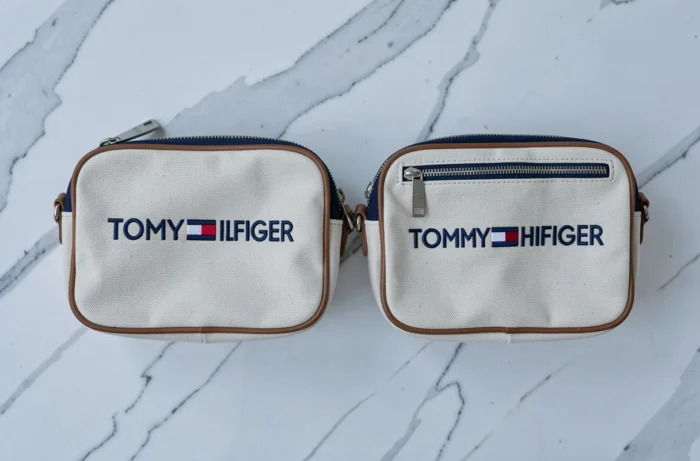
Among these five criteria, the flag logo remains the most discriminating. The 2×2 grid, composed of two navy blue rectangles (top and bottom) and two inner red and white rectangles, must display perfectly symmetrical proportions. A discrepancy, even slight, between the width of the red rectangle and that of the white indicates a copy.
To delve deeper into each verification point, several tips for spotting a genuine Tommy Hilfiger bag detail the step-by-step visual examination method.
Tommy Hilfiger Labels and Serial Numbers: Reading What Counterfeiters Overlook
The interior label contains a high number of errors on copies. On an authentic bag, it mentions the textile composition in percentages, the country of manufacture, and a style or reference number. The font used is clear, without smudges, and the text is uniformly aligned.
On a counterfeit, the most common anomalies are as follows:
- The font differs from that used by Tommy Hilfiger on recent collections, with letters that are too thick or too thin compared to the reference model.
- The indicated country of manufacture does not correspond to the brand’s usual production sites for the relevant product category.
- The serial number is absent, or printed in a blurry manner, with no possible match to accessible reference databases for consumers.
A serial number alone does not guarantee authenticity. Counterfeiters now reproduce credible sequences. It is the overall consistency between the label, material, and finishes that allows for a decisive judgment.
Consistency Between the Label and the Collection
Each Tommy Hilfiger collection uses specific style codes. A bag labeled with a code incompatible with its shape, color, or release season constitutes a serious warning signal. Specialized resellers check this correspondence before validating a product.
Closures, Hardware, and Finishes: The Details That Touch Reveals
The hardware of an authentic Tommy Hilfiger bag bears a legible brand engraving on the zipper pulls. The metal is smooth, with a noticeable weight. On copies, the engraving is often shallow or absent, and the metal has a dull hue or a pitted appearance.
The sliding of the zipper is a simple test. An authentic zip glides without resistance or snagging. On a counterfeit, the mechanism forces, skips, or gets stuck halfway. This detail, overlooked by hurried buyers, betrays the majority of copies.
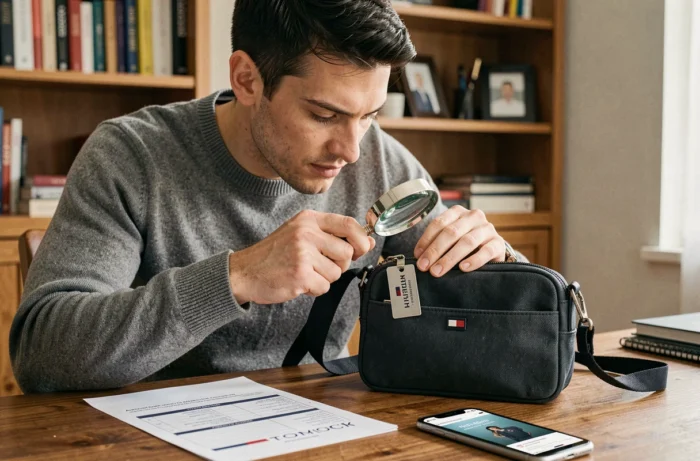
The interior lining deserves as much attention as the exterior. On an authentic product, it is sewn neatly, without stray folds or loose threads. The color and pattern of the lining match the exact model referenced by Tommy Hilfiger.
Traceability of Purchase and Legal Recourse in Case of Counterfeiting
Most authentication guides stop at the visual examination of the bag. According to a legal analysis published on August 28, 2026, by Kohen Avocats, the preservation of purchase evidence conditions the effectiveness of recourse. It is recommended to keep the original listing, order confirmation, proof of payment, delivery tracking, and exchanges with the seller or platform.
Legal Warranty of Conformity in France
In France, the legal warranty of conformity applies against the professional seller, not directly against Tommy Hilfiger. If the delivered bag does not match the description or claimed authenticity, the buyer has a period of two years to act, according to the same legal source.
However, on peer-to-peer sales platforms, the situation differs. The liability of the private seller is harder to engage, and the platform itself may have its liability questioned when the listing presented authenticity misleadingly. An inaccurate claim of authenticity in a listing may constitute misleading commercial practice.
What Online Sales Platforms Must Monitor
The obligations of platforms regarding the fight against counterfeiting have been strengthened. They must now respond to reports of counterfeit products and, in some cases, remove disputed listings. For the buyer, reporting a suspicious product to the platform is a useful preliminary step before any formal recourse.
The examination of a Tommy Hilfiger bag relies on the combination of visual checks and rigorous documentary traceability. The flag logo, stitches, label, and hardware form a bundle of clues. Systematic preservation of purchase evidence remains the only concrete lever if the product turns out to be non-compliant.