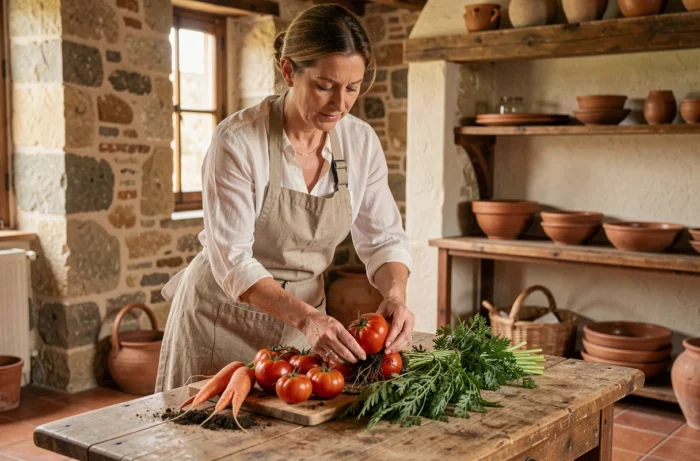
The organic label certifies a mode of production. It says nothing about the distance traveled by the product or the harvest date. Confusing these three parameters—certification, proximity, and seasonality—means neglecting the essentials that determine the nutritional quality and environmental impact of a food item. According to the Agence Bio, 28.3% of organic products consumed in France were imported in 2025. Cross-referencing the organic specifications with local sourcing requires a more nuanced understanding.
Import Rates of Organic Products: What the Sectors Reveal
Grocery items, fruits and vegetables, and dairy products are among the categories most affected by organic imports. This reality necessitates distinguishing between two approaches that are often conflated: buying organic and buying local.
An AB-certified coffee grown in Latin America meets the European specifications on synthetic pesticides, but its logistical carbon footprint is incomparable to that of organic wheat flour produced within a hundred kilometers. We recommend systematically checking the country of origin on the label, even in specialty stores.
The collection of organic milk has declined for the third consecutive year in 2025. The number of organic dairy farms has also decreased. On the consumption side, sales of organic products increased by 4.8% in value in the first half of 2026.
This gap between supply and demand creates pressure on imports, particularly for dairy products and certain out-of-season fruits. References available on superfora.be facilitate the cross-referencing of organic certification and local traceability in the supply chains.
Pesticide Residues and Organic Agriculture: Real Limits of the Specifications
Organic agriculture prohibits synthetic chemical pesticides, but not all phytosanitary treatments. Copper (Bordeaux mixture), sulfur, and certain bio-insecticides based on Bacillus thuringiensis are permitted. Their toxicological profiles differ, but they are not neutral for soils or aquatic organisms.
Transitioning to organic significantly reduces exposure to synthetic pesticide residues, particularly for children and pregnant women, populations for whom the effects of endocrine disruptors are well documented.
The technical nuance lies in the fact that an organic product is not guaranteed to be “zero residue.” Cross-contaminations (spray drift from a neighboring plot, shared irrigation) do occur. Choosing a local producer allows for knowledge of the actual agronomic context of the plot, which no label can guarantee from a distance.
Seasonality and Nutritional Quality of Organic Vegetables
An organic vegetable grown in a heated greenhouse in winter and then transported over several hundred kilometers loses some of its nutritional and environmental advantages. Seasonality remains the most underestimated parameter in discussions about healthy eating.
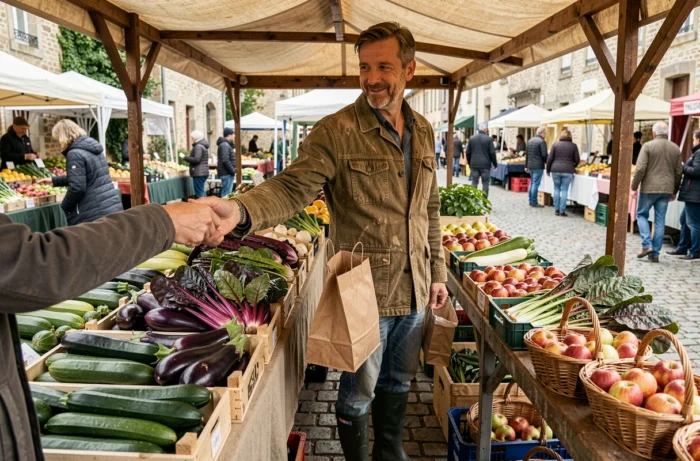
We observe that local short circuits naturally impose respect for the production calendar. A market gardener who sells directly does not offer tomatoes in January. This constraint, often perceived as a limitation, actually serves as a quality filter:
- Fruits and vegetables harvested at maturity contain more micronutrients than those picked green to withstand long-distance transport
- The time between harvest and consumption, reduced to a few days in short circuits, limits the degradation of vitamins C and B9, which are sensitive to light and oxidation
- The absence of prolonged cold storage preserves organoleptic qualities, particularly texture and volatile aromas

Local Economic Impact: Why Price Per Kilo Is Not Enough
Local organic products often cost more per unit. This observation, frequently repeated, masks a more complex economic reality. The price of conventional organic rarely incorporates negative externalities: water decontamination, public health costs related to pesticides, soil erosion.
Buying directly from a local producer eliminates several intermediaries. The margin goes back to the producer, stabilizing farms and limiting reverse conversions (returning to conventional due to lack of profitability). This phenomenon of deconversion affects several sectors, as evidenced by the decrease in the number of organic dairy farms in 2025.
Moreover, organic accounts for less than 6% of food consumption at home and about 1% of supplies for the restaurant sector. These figures, reported by the Agence Bio in September 2026, show that there is still considerable room for growth, particularly in collective catering where volumes could drive prices down.
Criteria for Evaluating a Local Organic Supplier
- Check the validity of the certification (the number of the certifying body is on the label or delivery note)
- Ask for the actual distance between the production site and the point of sale, not just the mention “local” without a defined perimeter
- Inquire about complementary agricultural practices: crop rotation, hedge management, soil cover in winter
- Compare the price per kilo while factoring in the reduction of waste, as local seasonal products generally keep better
The rebound in organic sales in 2026 should not overshadow the fragility of certain French production sectors. Choosing organic and local products daily requires going beyond the logo reflex to question the origin, season, and distribution method. Only under these conditions can organic fulfill its health and environmental promises.