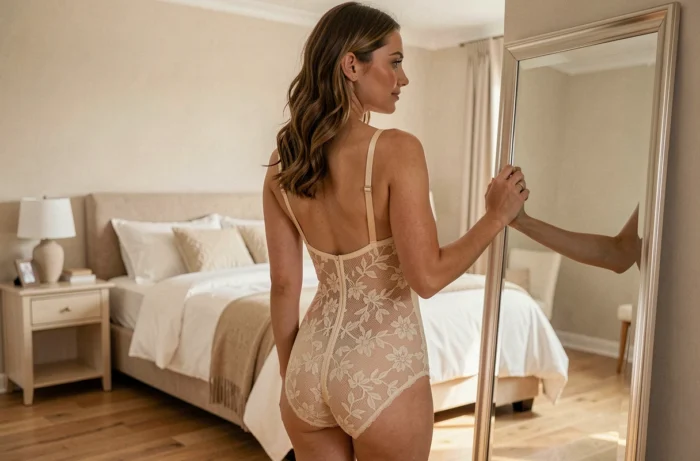
The bodysuit is the only piece of lingerie that simultaneously engages the bust, waist, and crotch in a one-piece cut. This triple anchoring imposes technical constraints that neither a bra nor panties present in isolation. Choosing a bodysuit for daily wear involves balancing residual elasticity, bust support, and pressure point management, three parameters that vary according to the pattern construction and textile composition.
Crotch tension and ergonomics of closure on a bodysuit worn all day
The closure at the crotch is where most prolonged wear abandon occurs. A bodysuit that is too short between the shoulder and the crotch creates a constant vertical pull that rides up the back and compresses the bust. We observe that torso length conditions comfort much more than standard size.
Double or triple snap closure systems allow for a vertical adjustment of one to two centimeters. Fabric-covered snaps reduce friction on bare skin compared to raw metal snaps. Opt for a bodysuit whose crotch base is wide enough to distribute tension over a larger surface area, which prevents the “string” effect after a few hours.
A detail often overlooked: the direction of the fabric grain in this area. A bodysuit cut on the bias at this precise point offers more lateral flexibility than a bodysuit cut on the straight grain, even with the same elastane content. If the label does not mention it, stretch the fabric diagonally at the closure. The difference in elastic recovery is noticeable to the touch.
For those wishing to discover Lingerie & Séduction online, sorting by torso length or type of closure facilitates this first technical filter even before considering style.

Textile composition of a lace bodysuit: elastane, polyamide, and durability
A lace bodysuit that sags after three washes has been poorly designed, not poorly worn. The durability of lace depends on its backing: a rigid lace placed on elastic tulle does not react like a knitted lace that stretches in both directions (bi-directional stretch).
For daily use, we recommend a composition where polyamide significantly exceeds the elastane content. A high ratio of polyamide ensures shape retention, while elastane provides comfort in stretch. When the elastane content is too high, the bodysuit quickly softens and loses its support.
Surface treatments and PFAS regulation
Some bodysuits benefit from water-repellent or stain-resistant finishes applied directly to the fabric. Regulation (EU) 2024/2462 severely restricts the use of undecafluorohexanoic acid (PFHxA) and related substances in consumer clothing starting in October 2026. In practical terms, traditional fluorinated finishes C6 will disappear from lingerie collections.
For a buyer, this means that “stain-resistant” bodysuits sold today will not be formulated the same way tomorrow. It is better to invest in untreated materials, certified OEKO-TEX Standard 100 class I (direct skin contact), which guarantee the absence of harmful substances without resorting to chemical surface finishes.
Bust support without underwires: construction techniques to check
Most guides direct towards the choice of “with or without underwires.” The more pertinent question is: what type of integrated support does the bodysuit offer in the absence of underwires?
- Princess seams (vertical seams starting from the shoulder or armhole down to the waist) structure the bust through the pattern itself, without rigid reinforcement. They are suitable for average busts and ensure a natural shape.
- Power mesh bands inserted under the bust replace the underwire with localized elastic compression. Their effectiveness depends on the width of the band: if too narrow, it rolls on itself.
- Preformed cups made of fine foam offer passive structural support. They fix the shape of the bust independently of the fabric tension, which is suitable for generous busts but adds thickness under a fitted garment.
The support of a bodysuit relies on the combination of pattern, reinforcement, and overall tension, not on a single element. A bodysuit with underwires but without structural seams at the back will eventually tip forward during the day.

Bodysuit and silhouette: cutting criteria for wearing undergarments
Wearing a bodysuit under a dress or high-waisted pants means that the piece creates no visible lines. Classic overlocked seams show more than a thermally bonded cut or ultrasonic welding. Seamless finishes (bonded seams) remain invisible under thin fabrics like jersey or crepe.
The cut of the integrated panties also plays a technical role. A high cut frees the top of the thigh and avoids demarcation under slim pants. A Brazilian cut, more covering on the buttock, limits the risk of riding up but may create a line under a pencil skirt.
Color and transparency under light clothing
The “nude” reflex is not universal. On light skin, a slightly pink bodysuit disappears better than a yellow beige. On dark skin, a bodysuit in a chocolate or coffee tone will be invisible where a so-called “nude” bodysuit would create a contrast. The reliable test is to press the bodysuit against the inner forearm under natural light.
A black bodysuit remains visible under a white garment, regardless of the thickness of the outer fabric. Conversely, a bodysuit in a shade close to the skin tone erases the boundary between skin and lingerie, allowing for wearing low-cut dresses without revealing the structure underneath.
Ultimately, the choice of a daily bodysuit comes down to details of construction that are not visible in a product photo: grain direction, width of the underbust band, type of welding. Handling the bodysuit before purchase, or at least reading the construction specifications carefully, remains the safest way to avoid a disappointing purchase.