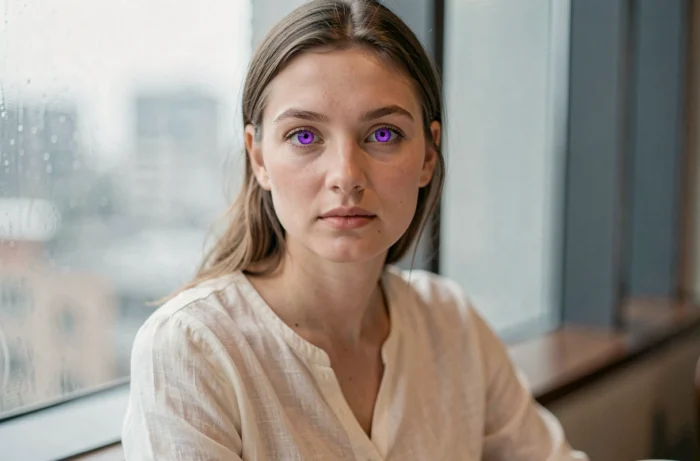
Purple eyes are among the most discussed iris colors in the history of cinema and popular culture. Elizabeth Taylor remains the figure most associated with this hue, to the point that the nickname “Violet Eyes” accompanied her throughout her career. The question of whether celebrities actually possess purple irises intertwines genetics, optics, and media construction.
Rayleigh Scattering and Stroma: What Produces a Purple Reflection in the Iris
The color of an iris does not depend on a purple pigment. No pigment of this hue exists in the human eye. The coloration results from the amount of melanin present in two distinct layers: the stroma (anterior layer) and the pigment epithelium (posterior layer).
When the stroma contains very little melanin, the light passing through it is scattered according to a phenomenon called Rayleigh scattering, the same one that gives the sky its blue color. Short wavelengths (blue, violet) are reflected back to the observer, while long wavelengths pass through.
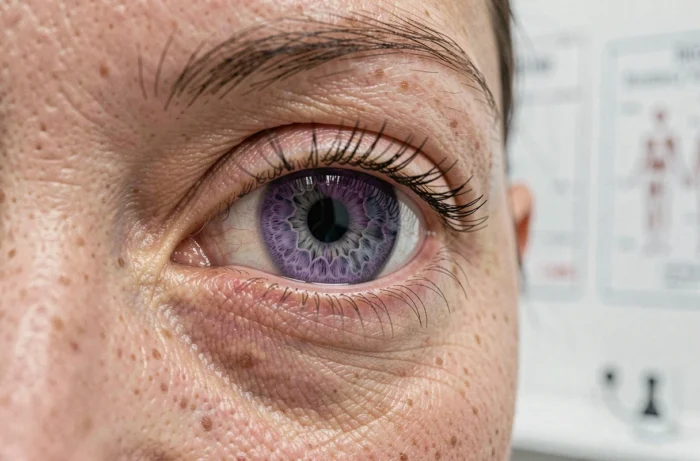
An iris perceived as purple implies a near-absence of melanin in the stroma combined with the visibility of blood vessels located behind it. The red of the capillaries, mixed with the scattered blue, produces an impression of purple. It is not a “painted” color in the eye; it is a composite optical effect.
As detailed in the dedicated article on Beauty Inc, this configuration is so rare that it concerns an infinitesimal fraction of the world’s population.
HERC2-OCA2 Genetic Complex: Why Purple Eyes Are Not an Autonomous Color
Recent genomic syntheses link the purple appearance of certain irises to the HERC2-OCA2 complex located on chromosome 15. These two genes control the production and distribution of melanin in the iris. Their interaction determines a continuum of pigmentation ranging from dark brown to very light blue.
The irises described as purple are at the lightest end of this continuum. It is not a distinct chromatic category, but an extreme configuration where pigmentation is so low that the optical effect described above becomes visible.
This genetic configuration brings the cases of “purple eyes” closer to certain forms of oculocutaneous albinism (OCA). Research on pigmentation genetics shows that the violet irises observed clinically share mechanisms with ocular albinism, without necessarily falling under a complete diagnosis of albinism. The boundary is blurred, and the available data do not allow classifying purple eyes as a standalone color.
Elizabeth Taylor and the Myth of Purple Eyes in Cinema
Elizabeth Taylor was photographed and filmed for over five decades. Her irises appear sometimes deep blue, sometimes blue-gray, and occasionally with a purplish reflection. Several factors explain these variations:
- The studio lighting of Hollywood productions from the 1940s to the 1960s, designed to flatter stars, significantly altered the perception of iris colors on Technicolor film.
- Stage makeup, particularly eyeshadows and shades applied around the eyes, created a contrast that accentuated the cool tones of the iris.
- The chromatic sensitivity of film stock varied by batches and development laboratories, introducing unpredictable color dominants.
Elizabeth Taylor had very dark blue irises, not purple. The myth was built up through accumulation: retouched photographs, calibrated lighting, and a nickname that became a trademark.
Other celebrities are regularly cited in lists of “stars with purple eyes.” In the vast majority of cases, the available images show blue irises photographed under specific lighting conditions, or retouched in post-production. Colored contact lenses, available since the 1980s, add an additional layer of confusion.

Alexandria’s Genesis: A Fanfiction Turned Urban Legend
Among the most persistent myths surrounding purple eyes, Alexandria’s Genesis holds a special place. This supposed genetic condition, said to give purple irises at birth as well as a series of extraordinary physical attributes (absence of body hair, immunity to diseases, exceptional longevity), has been circulating on the internet since the late 1990s.
Alexandria’s Genesis is a fiction. No medical publication, no registry of rare diseases, no genetic database references this condition. It has never been described in a clinical context.
Its persistence can be explained by the virality of social media and the allure of supposed biological rarities. Posts on TikTok and Instagram continue to present it as a medical fact, sometimes associating it with celebrities. This propagation mechanism illustrates the difficulty of correcting false information once it has reached a critical mass of shares.
Purple Reflections and Gaze: What Science Confirms Today
The perception of the color of an iris varies according to ambient brightness, the angle of observation, and the colors worn by the person. The same iris can appear gray, blue, or slightly purplish throughout the same day. This phenomenon, well documented in ophthalmology, does not mean that the color of the iris “changes”: it is the reflected light that varies.
Authentic cases of irises with a purplish reflection are associated with forms of ocular albinism, where the partial transparency of the iris reveals retinal vascularization. These individuals require regular ophthalmological follow-up from childhood due to increased photosensitivity and specific visual risks.
Purple eyes in the strict sense, as a stable and permanent color visible under all lighting conditions, have never been documented in the scientific literature outside contexts related to albinism. Purple remains a contextual optical effect, not a pigmentation. Between the Hollywood spotlights and the genetics of pigments, the boundary between myth and reality hinges on a handful of nanometers of wavelength.