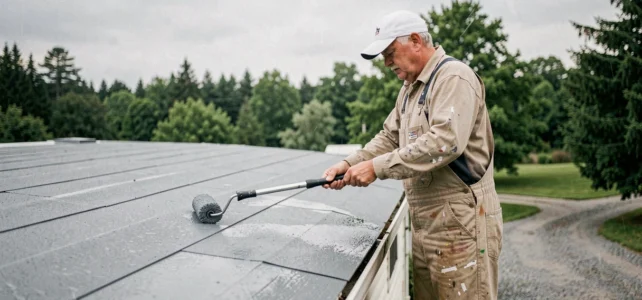
On a south-facing mobile home exposed for several seasons, the roof eventually becomes powdery, dulls, and sometimes even allows heat to pass through noticeably. Before embarking on the roof painting of a mobile home, one must deal with an atypical substrate: thin aluminum sheet, low slope, visible fastenings. The work is nothing like painting a traditional house roof, and preparation mistakes can be costly from the first winter.
Aluminum sheet of the mobile home: a substrate that does not forgive improvisation
The majority of mobile home roofs are made of lacquered aluminum sheet or sandwich panels with aluminum facing. This material has a particularity that many underestimate: it is non-porous. A standard paint, even of good quality, simply does not adhere to a smooth and slightly greasy surface.
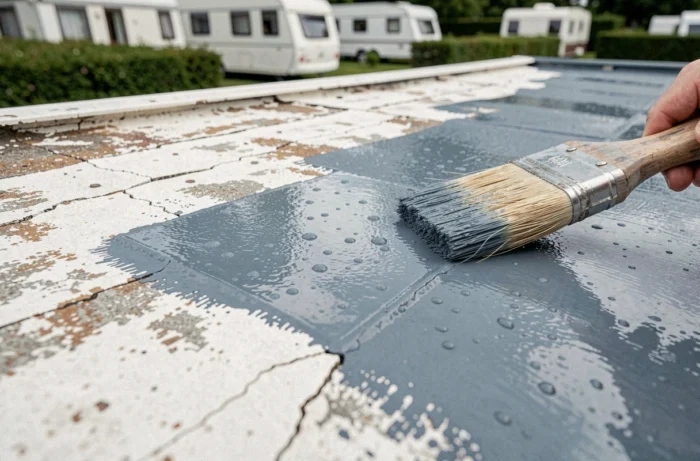
Therefore, one must go through a complete degreasing with acetone or a special cleaner for non-ferrous metals, followed by light sanding with fine grit to create micro-roughness. Without this step, the paint will blister at the first thermal expansion cycle. And on a mobile home roof, the temperature differences between day and night are severe, much more than on a ventilated tile roof.
The question of the primer is equally critical. A bonding primer formulated for aluminum is used (often based on epoxy or polyurethane resin). Universal primers sold in supermarkets do not hold on this type of substrate. To delve deeper into the topic of exterior paint for mobile home roofs, the constraints related to cladding and sheet metal are detailed according to each configuration.
Cool roof paint on mobile home: real effectiveness and limits to know
Thermo-reflective paints, known as “cool roof,” are increasingly appealing to mobile home owners. The principle is simple: a white or light coating that reflects part of the solar radiation instead of absorbing it. On a dark sheet, the difference in indoor temperature can be significant in the middle of summer.
The economic life simplification law of May 26, 2026, officially recognizes reflective roof coatings as a summer comfort solution. However, it positions them after photovoltaics and greening in the hierarchy of preferred solutions. On a mobile home, neither heavy solar panels nor greening are realistic. Cool roof paint thus often becomes the only viable option to reduce heat without altering the structure.
Feedback varies on this point: some users report significantly improved comfort, while others notice little difference when the insulation under the roof is almost non-existent. The CSTB, mandated by the DHUP in 2024, has shown that the effectiveness of reflective paints strongly depends on the building configuration (existing insulation, ventilation, orientation). On a poorly insulated mobile home, reflective paint reduces daytime overheating but does not replace the need for improved insulation.
Preparation and application: the steps that make the difference on a mobile home roof
One does not paint a mobile home roof at 35 °C in full sun, nor after rain. The ideal window is during dry weather, with moderate temperatures and a substrate that is neither burning nor wet. An overheated sheet causes solvents to evaporate too quickly and creates micro-bubbles in the paint film.
Cleaning and repair first
Before touching a brush, inspect every joint, every fastening screw, every sheet metal connection. Leaks on a mobile home roof rarely come from a hole in the sheet: they pass through loose fastenings and aged sealants. Replace faulty seals and tighten screws before any painting.
Cleaning is done with a low-pressure cleaner (not high pressure, which deforms the thin sheet) or with a soft brush and an appropriate detergent. Remove moss, lichens, and pollution residues, then rinse thoroughly and let dry for at least a full day.
Application of the paint: layers and tools
The standard protocol on an aluminum mobile home roof follows this order:
- One layer of special non-ferrous metal bonding primer, applied with a short-haired roller or an airless sprayer, with drying times respected according to the manufacturer’s technical data sheet
- A first layer of finishing paint (acrylic, polyurethane, or thermo-reflective depending on the objective), spread in cross passes to avoid localized overloads
- A second finishing layer applied perpendicularly to the first, necessary to ensure the film’s waterproofing and durability over time
The airless sprayer gives the best result on large flat surfaces, but the roller remains more accessible for an individual. Avoid using only a brush, which leaves marks and uneven thicknesses on the sheet.
Authorization to paint the roof: check the PLU and camping regulations
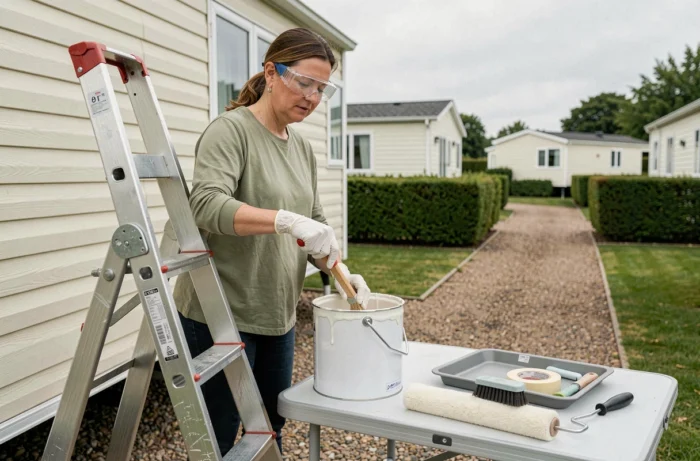
It is often forgotten, but changing the color of a roof may require prior declaration at the town hall, even for a mobile home. The local urban planning plan (PLU) sometimes imposes specific shades or prohibits white on roofs. If the mobile home is located in a campsite or a residential leisure park, the internal regulations may also restrict the allowed colors.
Before purchasing the paint, consult the town’s urban planning department and, if applicable, the camping management. A roof repainted in reflective white without authorization may lead to a formal notice to restore the roof to its original state.
Durability and maintenance of mobile home roof paint
A well-applied paint on a properly prepared substrate lasts several years before needing refreshing. Durability depends on three main factors:
- The quality of the primer and paint used (professional products for non-ferrous metals far outperform consumer paints)
- The strict adherence to drying times between each layer, often underestimated by hurried individuals
- Regular maintenance: an annual gentle wash with neutral soap is enough to prolong the coating’s lifespan and maintain the reflective properties of cool roof paint
The most stressed areas are the ridge connections and the edges, where water stagnates or flows in volume. Monitor these points every spring and touch up locally if the film starts to peel, rather than waiting for widespread degradation that requires a complete redo.
The choice between standard paint and thermo-reflective paint is made according to the use of the mobile home. For a leisure residence occupied in summer, cool roof provides a real comfort gain. For a mobile home inhabited year-round, combining reflective paint with improved insulation under the roof remains the most relevant combination.