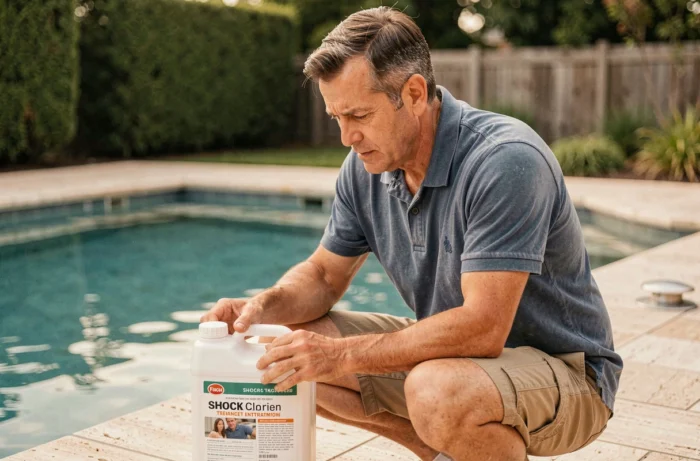
Shock chlorine is a common product used in pool maintenance, employed to correct green water or quickly eliminate chloramines. The temptation to pour this concentrated product directly into the skimmer exists because it is quick and the skimmer continuously draws in water. However, this practice exposes the filtration system to damages that most pool owners only discover when a breakdown occurs.
Concentrated shock chlorine in the skimmer: what happens in the pipes
When shock chlorine (granules, tablets, or liquid) is introduced into the skimmer, it comes into direct contact with a very small volume of water. The dissolution locally creates a chemical concentration that is unmatched by the rest of the pool.
This overconcentration does not remain confined to the skimmer basket. It travels through the pipe connecting the skimmer to the pump, then reaches the pre-filter and the pump body. As long as the filtration is running, the flow partially dilutes the product. As soon as the pump stops, the hyperchlorinated solution stagnates in the piping.
Recent field reports precisely document the consequences: the plastic of the pump cover and filter dome loses its original flexibility, becomes brittle, and cracks at the slightest tightening after repeated contact with concentrated products introduced via the skimmer. The O-rings, glued fittings, and pre-filter basket suffer the same fate.
The problem is therefore not limited to the skimmer itself. Many articles focus on the corrosion of the basket, but the weakening affects the entire suction-filtration circuit, from the skimmer to the filter.
Understanding the risks associated with using shock chlorine in the skimmer helps avoid costly repairs on parts that are generally not monitored.
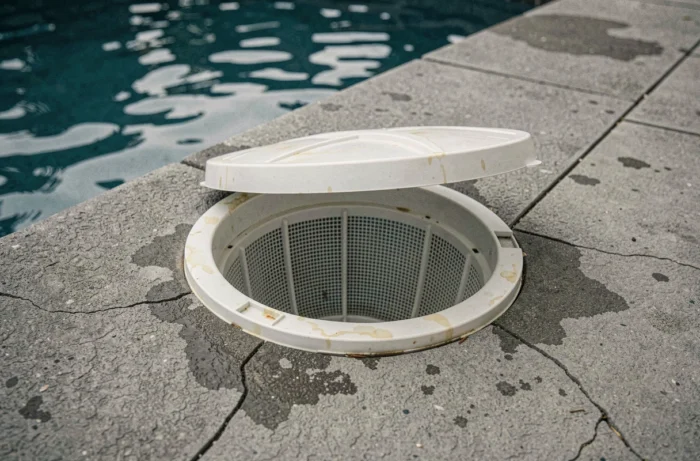
Filtration stopped and shock chlorine: the scenario of accelerated degradation
The filtration of a pool does not operate continuously. It stops at night, between programmed cycles, or during a power outage. It is during these stopping phases that the shock chlorine present in the skimmer produces its most aggressive effects.
The granules or tablets continue to dissolve in the still water of the skimmer. The stagnant solution reaches a corrosive concentration level that attacks the internal walls of the PVC pipe between the skimmer and the pump. This pipe, buried and invisible, gradually dries out from the inside.
The resulting micro-cracks cause two types of problems:
- Slow leaks in the buried pipes, often undetectable without an inspection camera, leading to chronic water loss and reduced filtration performance.
- Air intake at the weakened fittings, which causes the pump to lose prime and reduces the filtration flow without an apparent cause.
- A deformation of the pump cover or filter dome, which no longer seals tightly after a few seasons of exposure to concentrated chlorine.
This scenario is all the more insidious as it progresses slowly. The degradation unfolds over several months or seasons, making it difficult to identify the initial cause when the breakdown occurs.
Shock treatment of the pool: the recommended dilution method
Recent maintenance guides converge on a precise procedure for shock treatment, which excludes any passage through the skimmer. The logic is simple: dilute the product before it comes into contact with the filtration circuit.
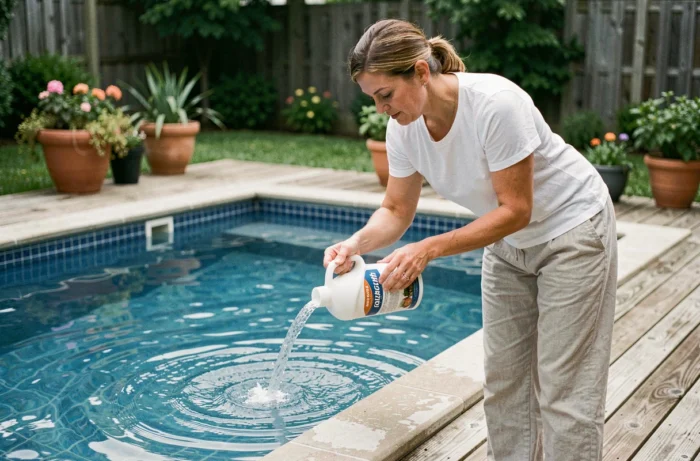
The method consists of dissolving the shock chlorine in a bucket of warm water, then pouring this diluted solution directly into the pool, in front of the return jets, with the filtration running. The current created by the jets distributes the product throughout the entire volume of water.
Three conditions must be met for the shock treatment to be effective without damaging the equipment:
- The filtration must run for the entire duration of the treatment (at least several hours) to ensure even distribution of chlorine in the pool.
- The pH of the water must be checked and adjusted before the shock treatment, as a pH that is too high significantly reduces the effectiveness of free chlorine against algae and impurities.
- No concentrated product (liquid chlorine, pH corrector, shock chlorine) should pass through the skimmer or the pump’s pre-filter basket.
Floating dispenser or dosing pump: alternatives to the skimmer for chlorine
If the issue of shock chlorine in the skimmer arises so often, it is because the search for convenience pushes owners toward the quickest solution. Alternatives exist for both daily treatment and shock treatment.
The floating dispenser remains the most accessible option. It allows for placing slow-release chlorine tablets in a compartment that gradually releases the product upon contact with the pool water. The concentration remains uniform throughout the pool volume, without chemical overload points.
For pools equipped with a complete technical room, an automatic dosing pump injects liquid chlorine directly into the return circuit, after the filter. This positioning ensures that the product never passes through the sensitive parts of the suction circuit.
The choice between these two solutions depends on the pool volume and the equipment budget. In any case, the skimmer should only serve its original role: to suck in surface water and retain debris in its basket before they reach the pump.
Pool maintenance and lifespan of filtration equipment
The lifespan of a pool pump, filter, and associated pipes directly depends on how treatment products are introduced into the circuit. An owner who regularly pours shock chlorine or pH correctors into the skimmer significantly reduces the longevity of these components.
The plastic parts of the suction circuit (pump cover, filter dome, fittings) are designed to withstand the normal chlorine levels in pool water, not a concentrated solution in prolonged contact. Replacing these parts prematurely represents an avoidable cost through a simple change of habit.
The reflex to adopt can be summarized in one sentence: all treatment products should first be diluted, then reach the pool through the return jets or a dedicated dosing device. The skimmer remains a surface collector, not a distributor of chemicals.