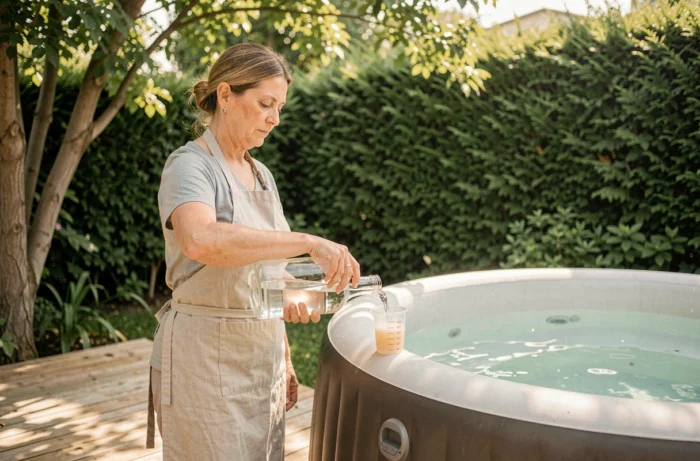
White vinegar often appears in eco-friendly maintenance recommendations for spas. However, the technical constraints differ radically between descaling a kitchen faucet and cleaning a spa equipment maintained at high temperatures. What real effectiveness does acetic acid offer on the various surfaces of a spa, and at what threshold does it become a factor of degradation?
Acetic Acid and Spa Materials: Comparative Compatibility
Commercial white vinegar typically contains between 4 and 8% acetic acid, giving it a pH close to 2.5. This level of acidity effectively acts on limescale, but it interacts very differently depending on the materials present in a spa.
| Material | Compatibility with Diluted Vinegar | Risk with Pure Vinegar |
|---|---|---|
| Acrylic Shell | Good (brief application, immediate rinsing) | Possible tarnishing with prolonged contact |
| Silicone Seals | Tolerated for short durations | Loss of elasticity, cracks, detachment |
| Non-Stainless Steel Parts | Not recommended even diluted | Accelerated corrosion (worsened above 35 °C) |
| Anodized Aluminum | Not recommended | Degradation of surface treatment |
| PVC (Inflatable Spa) | Good | Low risk, rinsing recommended |
Technical data on the corrosion of carbon steel by acetic acid shows that the corrosion rate significantly increases above 50 °C. However, the water in a spa commonly oscillates between 35 and 40 °C, which already places metal parts in a zone of increased vulnerability when in contact with undiluted vinegar.
This table highlights a point that many maintenance guides overlook: white vinegar does not pose a uniform problem. Some parts of the spa tolerate it well, while others do not at all. Adapting the dosage and method to each area is the only viable approach, as detailed in several spa tips on D Kom Déco dedicated to this subject.
White Vinegar Dosage for Spas: Thresholds Not to Exceed
Dilution changes everything. An 8% white vinegar used pure on a silicone seal is nothing like a solution diluted in equal parts with warm water. The distinction between these two uses determines whether the product cleans or degrades.
Cleaning the Shell and Waterline
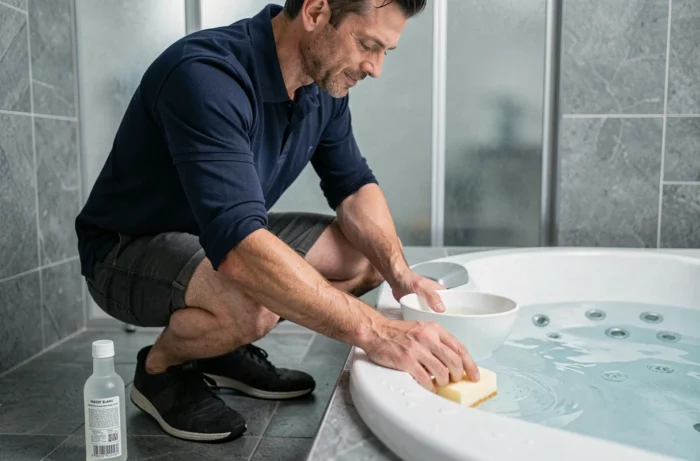
For the acrylic shell and waterline, a dilution of one volume of vinegar to one volume of water is sufficient to dissolve light limescale deposits. The application should be done with a soft cloth (microfiber), never with an abrasive sponge that would scratch the surface irreversibly.
Contact time should not exceed a few minutes before a thorough rinse with clear water. Forgetting to rinse leaves an acidic film that, over time, tarnishes the acrylic.
Soaking Cartridge Filters
The filter is the area where white vinegar provides the most added value. Soaking in a diluted solution (one volume of vinegar to two or three volumes of water) for a few hours dissolves mineral deposits that clog the filtration cartridge.
- Remove the cartridge and rinse it with a jet to eliminate visible debris before soaking
- Use a container large enough to fully immerse the filter, without bending or compressing it
- After soaking, rinse thoroughly with clear water and allow to air dry before reinstalling
- Never pour vinegar directly into the operating filtration system
This method extends the lifespan of the cartridge between replacements. However, it does not replace a specific pipe cleaner if the internal circuit is clogged with biofilms.
Pipes and Heater: Why Vinegar Is Not Enough
This is the tipping point between surface maintenance and internal circuit maintenance. Pouring white vinegar into the spa water to “flush the pipes” is a common practice, but its limits are real.
Vinegar has a low disinfecting power compared to chlorine or bromine. The pipes of a spa create a warm and humid environment conducive to the development of bacterial biofilms. Acetic acid does not effectively destroy these biofilms, which require an oxidizing treatment or a pipe cleaner formulated for this purpose.
The heater poses an additional problem. Its heating elements and their connections often contain metals sensitive to acidity. Regular passage of vinegar through the circuit accelerates the corrosion of these parts, especially at operating temperature. The replacement costs of a heater far exceed the savings made by avoiding a suitable maintenance product.
White Vinegar vs. Spa Maintenance Products: What the Discrepancies Reveal
The choice between white vinegar and dedicated products is not framed in terms of “natural vs. chemical.” It is framed in terms of scope of action.
- White vinegar excels at surface limescale (shell, waterline, cover, cartridge filter)
- Chlorine or bromine ensure continuous water disinfection, a role that vinegar cannot fulfill
- Specific pipe cleaners dissolve biofilms where vinegar only has a superficial effect
- Anti-limescale products formulated for spas act preventively without drastically lowering the water pH
Vinegar is a cleaning complement, not a substitute for water treatment. Replacing bromine or chlorine with white vinegar exposes one to rapid bacterial proliferation in an environment where temperature favors the multiplication of microorganisms.
A point often overlooked: pouring vinegar directly into the spa water causes a sharp drop in pH. Restoring the chemical balance afterward requires an adjustment with pH+ and a new measurement, which negates part of the intended savings.
White vinegar remains highly relevant for occasional cleaning of accessible surfaces and descaling of filters. For the hydraulic circuit, disinfectant treatment, and prevention of limescale in hot water, products formulated for the specific environment of a spa remain more reliable. Knowing this boundary helps avoid unnecessary spending on chemicals and costly repairs caused by miscalibrated use of vinegar.