The Prince Albert piercing passes through the urethral meatus and emerges at the level of the frenulum or slightly laterally in uncircumcised men. This anatomical feature, which allows the jewelry to pass through a mucous membrane, conditions the entire placement protocol, the choice of material, and the healing strategy. Here we detail the technical points that general guides often overlook.
Initial Gauge and Stretching of the Prince Albert Piercing
The choice of gauge for placement determines the stability of the jewelry and the tissue tolerance in the medium term. A diameter that is too thin increases the risk of migration and cheese-cutting (the jewelry slowly slicing through the tensioned tissue). We recommend never going below a gauge that is thick enough to distribute pressure on the edge of the meatus.
Progressive stretching is common with this piercing, as the tissue of the frenulum and urethral mucosa adapts relatively well to enlargement. Each gauge increase should respect a complete healing time between two stages. Forcing a stretch on still fragile tissue causes micro-tears that prolong the process and promote the formation of chaotic scar tissue.
Moving to a larger gauge should ideally be done with a lubricated insertion taper, never by forcing jewelry cold. If a clear resistance appears, one should give up and wait.
Materials and Geometry of Jewelry Suitable for Prince Albert
Implant-grade titanium (ASTM F136) remains the reference for placement and healing. Surgical steel contains nickel, a common allergen that causes contact dermatitis on mucosa, a tissue already stressed by the passage of urine. Niobium is a reliable alternative for sensitive wearers.
Regarding geometry, two options dominate: the segmented ring (BCR) and the curved barbell. The ring offers better natural drainage during healing, as it does not compress both openings simultaneously. The curved barbell is better suited for wearers who want a discreet profile under clothing. An overly tight ring creates constant pressure on the meatus and maintains chronic irritation.
When discussing the Prince Albert piercing, the compatibility between the jewelry and individual anatomy directly affects daily comfort and healing speed.
Post-Piercing Care Protocol: Saline Solution and Common Mistakes
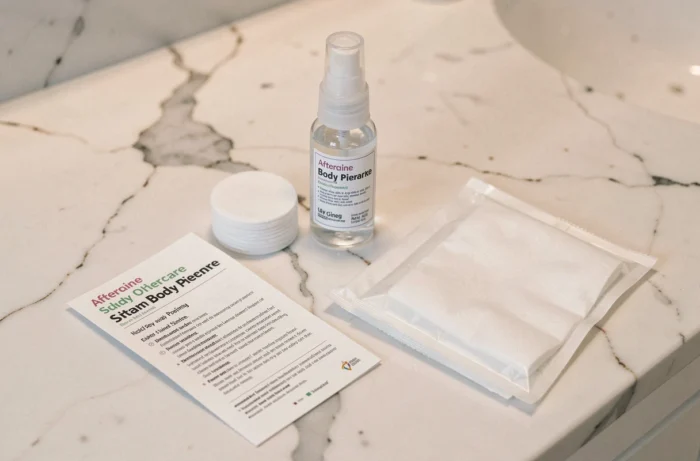
Cleaning is limited to one or two rinses per day with a ready-to-use sterile saline solution. Homemade mixtures (table salt and tap water) pose a dosage problem: too high a concentration dries out the mucosa, while too low a concentration does not clean. The isotonic saline solution in a single-dose spray eliminates this variable.
We regularly observe slowed healing in wearers who clean three or four times a day, twist the jewelry, or apply aggressive antiseptics (Betadine, alcohol, hydrogen peroxide). These products destroy the granulation cells that build new tissue. The principle is simple: the less you manipulate, the better the body works.
The most common mistakes during healing:
- Twisting or sliding the jewelry to “prevent it from sticking,” which tears the forming cells and reignites inflammation
- Using scented soap or shower gel directly on the area, causing chemical irritation of the mucosa
- Neglecting to dry after a shower, which maintains a humid environment conducive to bacterial proliferation
- Multiplying baths, pools, or hot tubs, which expose the open wound to concentrated bacteria and pathogens in stagnant warm water
Resuming Sexual Activity and Managing Friction
Resuming sexual intercourse and masturbation is discouraged during the first few weeks. The healing tissue does not tolerate repeated friction or the mechanical pressure of intercourse. Resumption should only occur when the tissue tolerates daily manipulation well without redness or pain.
Upon resumption, using a condom protects the wound from the partner’s bodily fluids and reduces the risk of cross-infection. A water-based lubricant, free from fragrance or warming agents, limits micro-trauma around the jewelry.
Wearing loose and breathable underwear throughout the healing phase significantly reduces accidental catches. Cotton boxers reduce friction and moisture compared to tight synthetic fabrics. At night, sleeping without underwear or with loose shorts avoids tension on the jewelry during sleep.
Warning Signs and Consultation in Case of Complications
A slight clear lymphatic secretion and yellowish crusts around the jewelry are normal during healing. What is not normal: a thick greenish or grayish discharge, pain that intensifies after the first week, persistent local warmth, or swelling that progresses instead of regressing.
Jewelry migration is visually detectable: the distance between the entry and exit points of the jewelry decreases, and the tissue thins. This phenomenon requires quick removal before the jewelry completely passes through and leaves a wider scar.
- Fever associated with diffuse redness around the piercing: consult urgently, as a local infection can progress to soft tissue cellulitis
- Heavy bleeding that resumes after the first week without identified trauma: check for the absence of vascular injury
- Allergic reaction (intense itching, peripheral eczema): change material to titanium or niobium and consult if symptoms persist
Post-placement follow-up with the piercer who performed the procedure remains the most reliable reflex. A visual check a few weeks later allows for verification of the jewelry’s positioning and adjustment of the ring’s diameter if the area has deflated. In case of doubt about an infection, a doctor remains the only competent interlocutor to prescribe appropriate treatment without prematurely removing the jewelry.