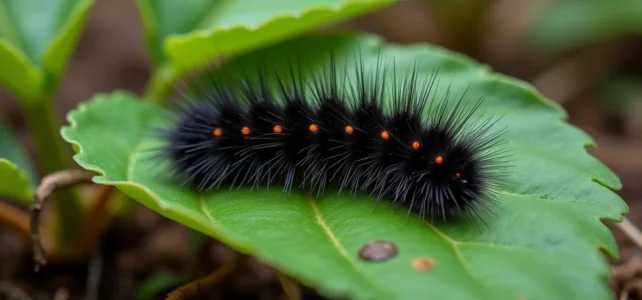
The hairiness of a black caterpillar does not provide information about its taxonomic family or its degree of danger. Only a cross-reading of morphological, behavioral, and phenological criteria allows for reliable identification. Here, we detail the points of analysis that popular guides often overlook.
Urticating or defensive hair: morphological distinction among black caterpillars
Not all hairy black caterpillars have urticating hairs. Urticating setae are hollow structures containing an allergenic protein, thaumetopein, characteristic of processionary caterpillars. These microhairs detach at the slightest contact or air current.
Defensive hairs, on the other hand, are solid, longer hairs, often grouped in tufts or brushes. They are found in Arctiidae (tiger moths) like the caterpillar of the Garden Tiger Moth (Arctia caja), which is black with reddish-brown tufts. These hairs can mechanically irritate the skin but do not release any toxins.
To find out how to identify a hairy black caterpillar, we recommend observing the structure of the hairs under a magnifying glass: urticating hairs are short, fine, and almost invisible to the naked eye, while defensive hairs form well-visible clusters.
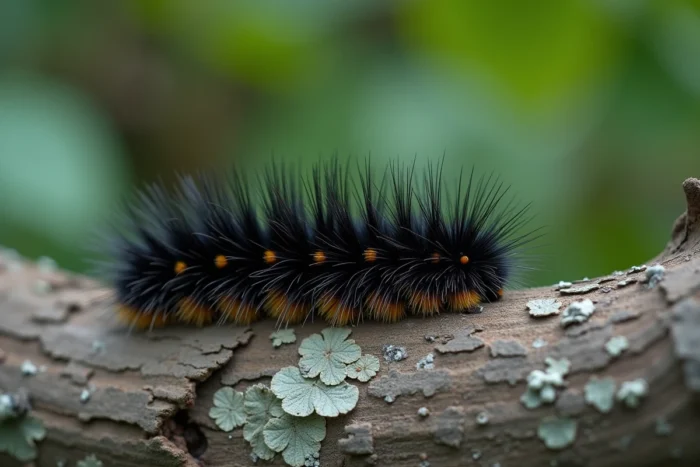
Hairy black caterpillars in France: the most common species and their distinguishing criteria
The recurring problem of identification arises from the fact that several species share a black, hairy phenotype at certain larval stages. We distinguish three functional groups.
Late-stage Pine Processionary Caterpillar
The caterpillar of Thaumetopoea pityocampa appears orange-brown in the early stages, then darkens dorsally from the third larval stage. The distinguishing criterion remains its gregarious behavior: these caterpillars move in a line and weave a silky white nest in pines or cedars. Their hairiness becomes highly urticating from mid-May and remains so until mid-July.
Black Arctiidae Caterpillars
The Garden Tiger Moth and the Woolly Bear (Arctia villica) produce very hairy black caterpillars that are solitary and found on the ground in gardens, meadows, and forest edges. The absence of a nest and procession movement immediately distinguishes them from processionary caterpillars. Their host plants are varied: nettle, plantain, dandelion.
Hawk Moths and Lasiocampidae
Some Lasiocampidae (Lasiocampa quercus, the Oak Moth) go through a very hairy brown-black caterpillar stage. They live on broadleaf trees (oak, sloe). Their large size (up to several centimeters at maturity) and light lateral bands differentiate them from processionary caterpillars.
Field identification criteria for a hairy black caterpillar
In practice, we use a five-point observation grid, applicable without specialized equipment.
- Host plant: a hairy black caterpillar on a pine or cedar points to the pine processionary caterpillar. On an oak, it points to the oak processionary or the Oak Moth. On a low herbaceous plant, it points to the Arctiidae.
- Social behavior: processionary caterpillars are gregarious and move in a line. Arctiidae and most Lasiocampidae are solitary.
- Presence of a nest: a white silk cocoon in the tree indicates a colony of processionary caterpillars. Other hairy black species do not weave a collective nest.
- Type of hair: short and nearly invisible hairs (processionary) versus long and dense tufts (Arctiidae, Lasiocampidae).
- Observation period: pine processionary caterpillars descend to the ground in spring. Black Arctiidae are often encountered in autumn, before hibernation.
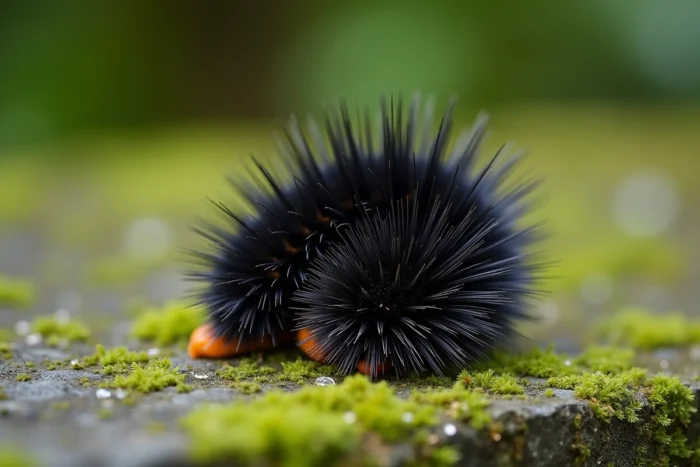
Safety protocol when encountering an unidentified hairy black caterpillar
Any unidentified hairy black caterpillar should be treated as potentially urticating. This universal precaution principle applies even if the species appears harmless.
Never crush, sweep, or blow on the caterpillar. Compression or blowing disperses urticating microhairs into the air, increasing the risk of inhalation and skin contact. Moving the animal with a shovel or a rigid cardboard, without compressing it, remains the recommended method. If in doubt about its danger, drowning the caterpillar in soapy water neutralizes the urticating hairs.
The hairs of processionary caterpillars remain active for several months after the caterpillar’s death, including in abandoned nests and burial sites. An empty nest in a pine in the middle of summer still poses a real risk.
Frequent confusion between hairy black caterpillars and oak processionary caterpillars
The oak processionary caterpillar (Thaumetopoea processionea) is more grayish than black, but its early larval stages are dark. It lives exclusively on oaks and forms silk patches on the trunk or main branches, not cocoon-shaped nests like the pine processionary caterpillar.
A hairy black caterpillar found on the ground, alone, far from any tree, is almost never a processionary. Processionary caterpillars only accidentally stray from the trunk or the procession line. This spatial criterion eliminates the majority of false alarms.
The distinction between hairy black species therefore relies less on color than on context: host tree, season, collective behavior, type of hair. An observer who masters these five field criteria will avoid most identification errors, especially risky handling.