
Trimming the top of a hedge of thuja that exceeds two meters, without a ladder and without asking for a helping hand: this is the situation that drives most gardeners towards a telescopic hedge trimmer. The tool solves a concrete problem of reach, but its weight at height, type of motorization, and blade geometry radically change the comfort of use from one model to another.
Actual reach of a telescopic hedge trimmer: what the technical sheet doesn’t say
Manufacturers announce impressive pole lengths. In practice, the usable reach mainly depends on the ability to hold the device above the head without shaking. A recent test published by Mon Jardin Ma Maison confirms that a reach of about 2.5 m is sufficient for most private hedges, provided you work in short sequences with a well-adjusted shoulder strap.
Beyond this distance, muscle fatigue degrades cutting precision within minutes. You end up straining your arms, the blade wobbles, and the result is no longer impeccable. It’s better to have a model around four kilos with an appropriate pole than a longer device that’s too heavy to stabilize. Detailed comparisons are available on taille-haie-telescopique.com, where the sheets include this notion of useful reach in real conditions.
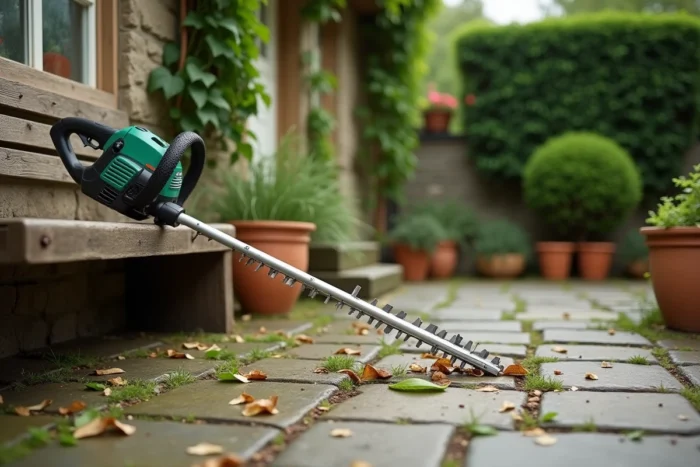
Double action blade and tooth spacing: the duo that changes the cut
On a standard hedge trimmer held at chest height, a medium blade is acceptable. On a telescopic model, every cutting defect is felt twice: you work farther from the hedge, with less visual control.
Single action or double action blade
A single action blade only moves one row of teeth. The result: more vibrations transmitted to the pole and a less clean shear. Double action blades reduce vibrations because both rows move in opposite directions. For telescopic use, this is the configuration to favor without hesitation.
Tooth spacing and branch diameter
The spacing between the teeth determines the maximum branch diameter that the tool can shear cleanly. For dense hedges of laurel or privet, aim for a spacing greater than 16 mm. Below that, branches get stuck between the teeth, the blade strains, and the motor wears out prematurely.
- Spacing less than 16 mm: suitable for young hedges, boxwood, and light finishing
- Spacing from 16 to 20 mm: versatile, suitable for most established garden hedges
- Spacing greater than 20 mm: reserved for very dense or semi-abandoned hedges with thick branches
Battery, corded, or gas: choose according to the garden configuration
The type of power supply cannot be chosen from a product sheet. It is chosen by looking at your garden: the distance between the electrical outlet and the hedge, the number of linear meters to trim, and whether or not there are neighbors sensitive to noise.
Battery-operated telescopic hedge trimmer
This is the segment that is growing the most. Recent models in 18 V or 36 V offer sufficient autonomy to trim an average-length hedge in one session. The absence of a cord frees movement around the hedge, a real advantage when working with a pole that needs to be pivoted often. However, the weight of the battery adds to that of the device, and feedback on this point varies by brand and generation of cells.
Note: starting in August 2026, European regulations on batteries will require more transparent labeling (capacity, chemistry, substances). This will allow for better comparison of batteries between manufacturers.
Corded telescopic hedge trimmer
Lighter than a battery model (no battery pack), the corded option remains relevant when the hedge runs along the house or garage. The constraint of the cable becomes a real problem as soon as you exceed about twenty meters of extension, especially when handling a pole at height. The risk of cutting the cord with the blade is real and happens more often than one might admit.
Gas telescopic hedge trimmer
Reserved for long hedge lengths or professional use. The power is higher, but the weight, noise, and vibrations make it tiring to use on a telescopic pole. For a standard-sized garden, it is rarely the right choice.
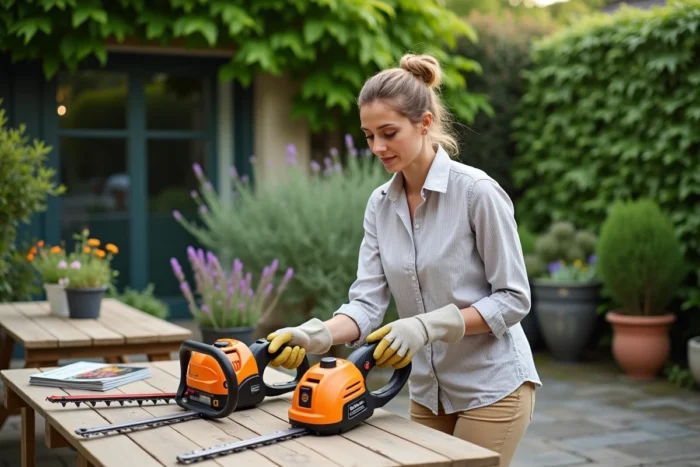
Pivoting head and harness: two details that become priorities at height
On a standard hedge trimmer, the fixed head poses no problem. On a telescopic model, a pivoting head allows you to trim the top of the hedge flat without twisting your wrists or tilting the entire device. Most models offer several tilt positions. Check before purchase that the head locking mechanism is solid: a system that unlocks under strain renders the tool unusable.
The shoulder harness, often sold separately, is not a secondary accessory. It transfers part of the weight of the pole to the torso and shoulders, allowing you to hold it longer without pain. If the manufacturer does not offer a compatible harness, it’s a signal: the tool was probably not designed for prolonged use at height.
- Check the number of positions of the pivoting head (three to five depending on the models)
- Test the head locking system before intensive use
- Prefer a harness with shoulder padding and quick release to alternate between cutting and resting phases
- Ensure that the harness attachment point is located at the center of gravity of the device, not at the end of the pole
The French Office for Biodiversity recommends avoiding hedge trimming between March 15 and July 31, during the nesting period of birds. A well-chosen telescopic hedge trimmer does not exempt you from respecting this schedule. The best time to use the tool remains the end of summer or the beginning of autumn, when the hedge has finished its annual growth and the nests are empty.