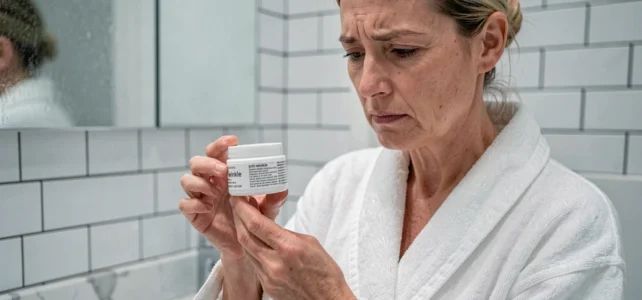
The Wrinkle Power Filling relies on an optical filling mechanism through a tightening film, not on a dermo-structural action. This distinction matters: the reported side effects do not stem from a classic pharmacological reaction, but from an interaction between a film-forming polymer and a sometimes compromised skin barrier. Here we analyze the real risks, beyond the marketing discourse surrounding this anti-wrinkle serum.
Film-forming Mechanism of Wrinkle Power and Induced Skin Stress
The active ingredient claimed by this type of product is a tightening complex that, when drying on the skin’s surface, creates a mechanical contraction of the hydrolipidic film. This contraction gives the illusion of an immediate smoothing of wrinkles.
The problem lies downstream. The traction exerted by the film disrupts the barrier function of the epidermis, particularly on mature skin where the stratum corneum is already thinned. On a dehydrated face or one weakened by exfoliating treatments, this repeated mechanical stress can accelerate transepidermal water loss and cause chronic micro-irritations.
We observe that most consumer articles describe tingling and redness as “normal and transient” effects. In reality, these signals indicate a partial breakdown of the skin barrier. Repeating this daily keeps the skin in a state of low-grade inflammation.
To better understand the side effects of wrinkle power, it is necessary to distinguish the initial reaction (contraction, pulling) from the progressive degradation that sets in with prolonged use.

Wrinkle Power and Ocular Risks: An Underestimated Danger
The application of the Wrinkle Power serum is primarily around the eyes, on crow’s feet and fine lines of the lower crow’s feet. This peri-orbital area presents a specific problem that the instructions downplay.
An accidental contact with the cornea can cause epithelial damage. For several years, ophthalmologists have been alerting to ocular complications related to cosmetics applied too close to the eye: pain, photophobia, temporary vision loss, eyelid edema. These symptoms require urgent consultation.
The risk increases significantly for contact lens wearers. The tightening film can migrate under the lens by capillarity, creating mechanical abrasion of the cornea. We recommend systematically removing lenses before applying any Wrinkle Power-type product around the eyes.
Documented Usage Errors with Syringe-Format Serums
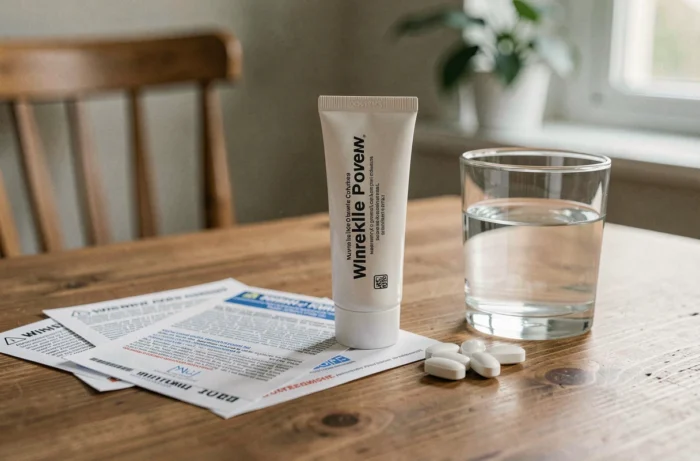
The syringe packaging of Wrinkle Power Filling is not trivial. Cases of confusion between liquid cosmetic serums and eye drops have been documented, leading to direct corneal damage. The mimetic format (dose syringe, fine tip) encourages this type of error, particularly among the elderly or visually impaired.
Storing the product away from personal pharmacy is a basic precaution, rarely mentioned by retailers.
Composition of the Wrinkle Power Serum: Ingredients to Watch for Skin
The formulation of this type of product raises several points of vigilance. The main risks lie in three categories of ingredients:
- Fragrance allergens: since the implementation of new European rules on the labeling of fragrance allergens, manufacturers must individually declare each allergenic substance above a certain threshold. Wrinkle Power, like many serums sold online, does not always clearly specify the presence of these compounds on its sales platforms.
- Synthetic film-forming polymers: these texture agents responsible for the “lifting” effect can cause contact dermatitis in reactive skin, with results sometimes confused with eczema.
- Broad-spectrum preservatives: their concentration, even compliant with regulations, becomes problematic when applied daily to such a delicate area as the eye contour or forehead wrinkles.
A technical point often overlooked: the stability of the product after opening is not guaranteed beyond the indicated PAO. An oxidized serum releases irritating by-products that amplify side effects.
Pregnant Women and Wrinkle Power: Contraindications Missing from Instructions
No specific safety data for pregnant women is available for Wrinkle Power Filling. This silence does not equate to safety. Tightening serums frequently contain synthetic peptides and skin penetration agents whose transdermal passage, even minimal, has not been evaluated in a pregnancy context.
We recommend that pregnant women avoid any immediate lifting serum without prior dermatological advice. The precautionary principle applies even more so as the product’s benefit is purely cosmetic and temporary.
Interactions with Other Facial Treatments
Applying Wrinkle Power after a treatment containing retinol or exfoliating acids (AHA, BHA) multiplies the risk of irritation. The tightening film traps the actives beneath the surface, increasing their contact time with already sensitized epidermis. The results on the face then become not just a simple smoothing, but persistent redness accompanied by peeling.
Respecting a delay of at least twelve hours between an active treatment and the application of a film-forming serum significantly limits this risk.
Anti-Wrinkle Claims and European Cosmetic Regulation
Claims such as “reduces wrinkles in seconds” are governed by the European regulation on cosmetic claims. A claim must be supported by evidence proportionate to the claimed effect. In vivo tests on a few dozen volunteers, common in this segment, do not constitute proof of lasting effectiveness.
The problem with Wrinkle Power does not lie in acute toxicity, but in the gap between the promise (visible rejuvenation) and reality (temporary masking by film). This gap leads to overuse of the product to maintain the effect, which mechanically increases exposure to irritating ingredients and risks to skin health.
Before integrating such a serum into a facial care routine, a patch test on the inner elbow for 48 hours remains the minimum. Sensitive skin, atopic skin, and individuals undergoing active dermatological treatment should refrain without medical advice. The true anti-wrinkle, to date, remains daily sun protection and moisturizers formulated without aggressive tightening agents.