The French wedding market is undergoing a rapid restructuring phase, driven by new expectations regarding experience, legal framework, and personalization. The emerging wedding trends for upcoming ceremonies are no longer limited to aesthetic choices: they also involve the management of personal data, image rights, and the use of artificial intelligence by service providers.
Image Rights and Ceremony: What Recent Case Law Changes
Couples wishing to organize an unforgettable ceremony must now integrate a legal dimension that is often overlooked. A decision by the Court of Cassation on June 23, 2026, has strengthened the requirement for consent for capturing and transmitting images in private settings. Specifically, filming or photographing guests during a wedding, and then sharing those images, even within a small circle, requires explicit agreement.
This evolution directly impacts several common practices: photographers who publish snapshots on their professional networks, videographers who edit teasers shared online, or guests who post real-time stories. Guest consent can no longer be presumed, even in a private setting.
Field feedback on this point varies. Some wedding planners are already incorporating a consent form into the welcome booklet, while others believe the issue falls under common sense without formalization. Available data does not allow for conclusions about the proportion of weddings adopting these practices, but the trend is clearly towards tightening.
Phone-Free Weddings: An Aesthetic Trend or Legal Precaution
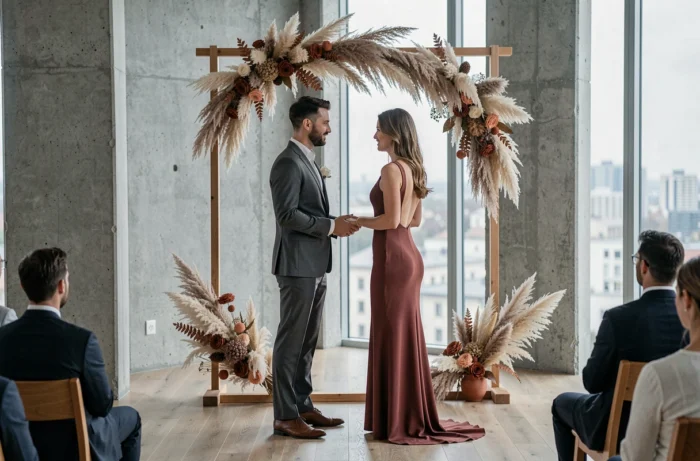
The so-called “unplugged” ceremony, where guests are asked to put away their phones, has been gaining traction for several seasons. Competing articles present it as a style choice, a way to refocus attention on the couple. The legal angle tells a different story.
A private photo gallery shared only among guests does not have the same status as a publication on an open social network. Asking guests not to use their devices during the civil or religious ceremony reduces the risk of non-consensual dissemination, aligning with the concerns raised by recent case law. Several event service providers, reported on the Univers Mariage website, document this convergence between aesthetic choice and compliance with image rights.
Limiting phones protects both the atmosphere and the privacy of guests. For couples who are hesitant, offering a unique professional photographer and a secure private gallery is becoming an increasingly common compromise.
Artificial Intelligence and Wedding Service Providers: Transparency Obligations
Since August 2, 2026, certain obligations of the European AI Act apply to synthetic content and the use of generative AI. Wedding service providers are affected at several levels:
- Photographers who retouch or generate visuals via AI must disclose the use of synthetic content when intended for public dissemination.
- Wedding planners using AI tools to write ceremony texts, invitations, or marketing content are subject to transparency rules towards their clients.
- Content creators (videographers, graphic designers) producing AI-assisted edits for social media must clearly identify the generated elements.
The AI Act imposes transparency on content generated by artificial intelligence, including in the event sector. Couples hiring these providers have the right to know which parts of their content were produced or modified by an algorithm.
Management of Guests’ Personal Data
GDPR compliance is not new, but it is becoming a concrete operational issue for event service providers. Guest lists, contact details collected for seating plans, email addresses obtained for sending photo galleries: all this data falls under the European regulation.
Every provider handling guest data must justify a legal basis for their processing. Recent recommendations emphasize the need for subcontracting contracts between the couple (data controller) and the providers (subcontractors), a formalism that the majority of weddings still overlook.
Personalization of the Civil Ceremony: Beyond Decoration
The civil ceremony remains one of the most sought-after formats by couples who want to organize a wedding that reflects their image. However, personalization is no longer solely about the choice of venue or floral decoration. Current trends favor a complete staging of the guest experience.
- The symbolic rituals chosen by the couple (sand ceremony, tree planting, letter exchange) are tailored to the couple’s story rather than taken from a standard catalog.
- The organization of the cocktail reception includes interactive activities (mobile cocktail bars, culinary workshops) that replace the classic static format.
- The choice of reception venue is guided by narrative coherence with the couple: a reception hall is no longer sufficient; the overall setting must tell a story.
This approach requires significantly longer preparatory work. Engagements become a period of creative design, not just logistical booking. Staging replaces simple decoration as a differentiating criterion between weddings.
Decoration Ideas and Color Choices
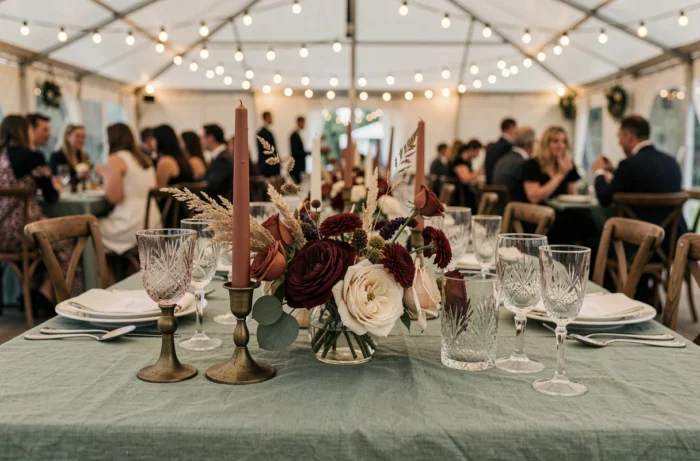
Monochrome or bicolor palettes dominate recent inspirations. Green, already identified as a key color, is available in deep tones (sage, olive) paired with natural materials. Fabric draping and mirror play complement the setups, while floral arrangements tend towards more streamlined formats, sometimes reduced to a single large variety.
The choice of theme remains personal, but field feedback shows that couples opting for strict coherence between invitation, decoration, and attire achieve more striking photographic results. It is not a matter of budget, but of maintaining a guiding line from the invitation to dessert.
The wedding trends of this period are characterized by a shift in focus: less spectacular decoration, more rigor on rights, transparency, and narrative coherence. An unforgettable wedding is prepared as much with the lawyer as with the florist.