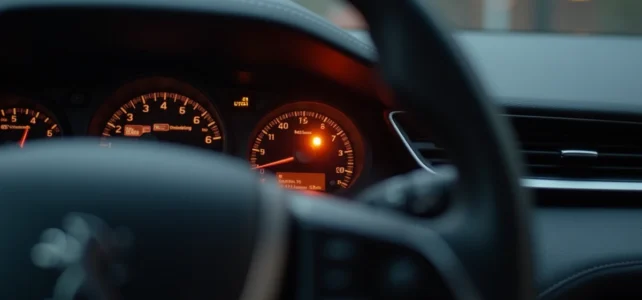
An orange warning light on the dashboard of a Peugeot 5008 indicates an anomaly detected by the engine control unit. The severity varies significantly depending on the type of light, its shape, and its behavior (steady or flashing). We will detail the most common technical causes, recent recalls directly affecting this model, and the steps to take to prevent mechanical deterioration.
Recalls for 1.5 BlueHDi on Peugeot 5008: Check Before Any Diagnosis
Before connecting a diagnostic tool, we recommend checking if the vehicle is subject to a manufacturer recall campaign. Since 2025, the 1.5 BlueHDi engines installed in several Stellantis models, including the Peugeot 5008, have been targeted by official recalls with direct consequences on the activation of the orange light.
The first recall (codes NY5 and MXL, alerts SR/02583/25, SR/02655/25, SR/02658/25) concerns the reinforcement of the camshaft chain, increased from 7 to 8 mm. The cause: oil carbonization that generates excessive pressure on the chain, potentially leading to its breakage. The engine light then illuminates upstream, sometimes without any noticeable symptoms while driving.
A second recall from April 2026 targets a faulty water pump pulley that may cause a timing belt misalignment. The consequences range from loss of power to complete engine failure, with the orange light systematically illuminating.
To check the vehicle’s eligibility, simply enter the VIN number on the manufacturer’s portal or contact the dealership directly. An OBD diagnosis performed without this prior verification risks missing a problem covered by the recall warranty.

Fault Codes and OBD Diagnosis on Peugeot 5008: Recurring Failures
The orange engine light on a 5008 corresponds to one or more fault codes recorded in the control unit. To understand the orange lights on Peugeot 5008, it is necessary to distinguish the families of codes according to the affected system.
Fuel Injection and Supply
Codes related to injection are among the most common. A clogged or faulty injector generates an unbalanced air/fuel mixture. The control unit then enters degraded mode to protect the catalyst. On PureTech gasoline engines, premature clogging of the injectors and abnormal oil consumption are documented issues that regularly trigger the light.
Pollution Control System: DPF and NOx Sensors
On diesel versions, a saturated particulate filter (DPF) is a classic cause. The message “engine fault, please repair the vehicle” often accompanies the orange light when the DPF regeneration fails repeatedly. The differential pressure sensors upstream and downstream of the DPF are also known points of failure.
Engine and Turbo Sensors
The air mass meter, lambda sensor, and boost pressure sensor (turbo) complete the list of components to monitor. A turbo that no longer builds pressure correctly causes an immediate loss of power, accompanied by a steady orange light.
- P0xxx codes: generic anomalies (injection, ignition, emissions) readable by any standard OBD tool
- P1xxx and P2xxx codes: specific Stellantis manufacturer codes, often requiring a compatible PSA tool (Diagbox, Lexia) for complete decoding
- U1xxx codes: communication faults between control units, common after a failed software update or a CAN network issue
Steady or Flashing Engine Light: Severity and Actions to Take
A steady orange light indicates a non-critical fault but should be addressed quickly. The vehicle can still be driven, often in degraded mode with reduced power. We observe that most drivers continue to drive for several weeks in this condition, which often exacerbates the initial problem.
A flashing orange light requires an immediate stop of the vehicle. The flashing generally indicates misfires that send unburned fuel into the catalyst. Continuing to drive under these conditions can destroy the catalyst in just a few dozen kilometers.
The distinction between these two behaviors of the light radically changes the diagnosis and repair cost. An immediate stop in response to a flashing light can prevent a modest repair (ignition coil, spark plug) from turning into a complete catalyst replacement.

Technical Inspection and Orange Engine Light on Peugeot 5008
Since the tightening of technical inspection requirements, an illuminated engine light on the dashboard constitutes a reason for major failure leading to a re-inspection. The inspector now visually checks the status of the lights at startup. A persistent orange light after the engine startup phase systematically triggers an unfavorable observation.
The Euro 6d pollution standards and the preparation for Euro 7 reinforce this trend. The onboard OBD system is queried during the inspection to verify emission compliance. An active fault code related to the pollution control system (DPF, EGR, catalyst, lambda sensor) blocks the validation of the inspection.
- Check and resolve any engine light at least one month before the technical inspection date
- Clear the fault codes after repair, then drive sufficiently for the OBD monitors to return to “ready” status
- Keep the repair invoice: the inspector may request it in case of a close re-inspection
An orange light on a Peugeot 5008 does not always mean a heavy repair, but the diagnosis must be methodical. Checking manufacturer recalls, reading fault codes with the appropriate tool, distinguishing between steady and flashing lights: these three steps, in this order, help guide the repair without randomly replacing parts.