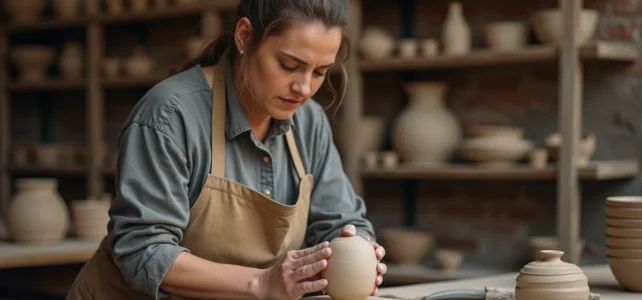
Abstract clay sculpture holds a unique place in contemporary ceramics. While figurative art imposes proportions to be respected, abstraction requires mastery of a vocabulary of shapes, volumes, and planes without direct anatomical reference. What technical parameters truly distinguish an abstract approach from figurative modeling, and how do these differences influence the choice of materials, tools, and the working process?
Abstract sculpture and figurative sculpture in clay: what changes concretely in the process
The distinction between abstraction and figuration is not limited to artistic intent. It alters the progression of each step, from the choice of clay to firing. The table below compares the parameters that vary the most from one approach to another.
| Parameter | Figurative Sculpture | Abstract Sculpture |
|---|---|---|
| Starting visual support | Photos, anatomical sketches, live model | Sketches of volumes, paper models, gestural intention |
| Internal structure | Framework based on the skeleton (vertical axis, pelvis, shoulders) | Free framework, often asymmetrical, dictated by the balance of masses |
| Dominant technique | Alternating addition and removal to refine proportions | Work by planes and tensions, assembly of independent volumes |
| Hollowing | Follows anatomical shapes (skull, torso) | Can be partial or absent if the piece is built hollow from the start |
| Surface finishing | Smoothing, details (eyes, skin folds) | Raw textures, tool imprints, matte/shiny contrasts |
In figurative sculpture, the framework reproduces a simplified skeleton. In abstract sculpture, it becomes an engineering problem unique to each piece: a cantilever, a tensioned curve, or a stacking of volumes require custom solutions.
Diving deeper into abstract clay sculpture techniques helps understand how these structural choices condition the final result well before the modeling phase.
Clay and tools for abstract sculpture: advanced selection criteria
The choice of clay conditions the range of shapes that can be achieved. A clay with a high chamotte content (fired clay particles mixed with the paste) better supports thick walls and unbalanced shapes. It reduces shrinkage during drying and limits cracks on large pieces.
In contrast, a fine clay without chamotte allows for smooth surfaces and sharp edges, suitable for geometric sculptures where the precision of planes matters more than structural strength.
Game-changing tools in abstraction
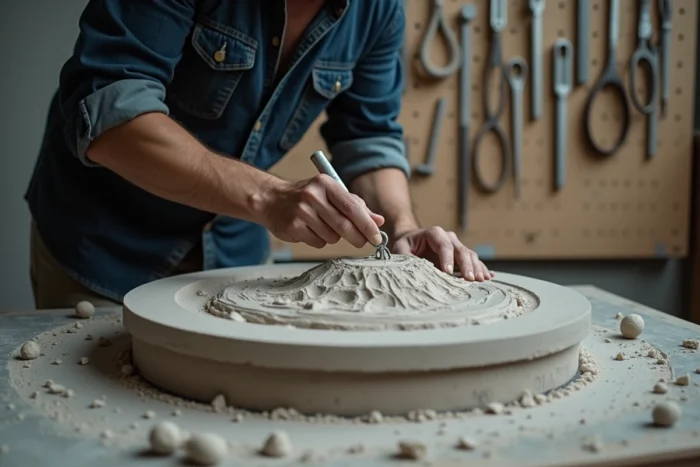
The classic modeling tools (ribs, modeling tools, cutting wire) remain useful. The difference lies in a few less common instruments:
- Templates cut from cardboard or thin metal, used to check the regularity of a curve or the symmetry of a plane along the length of a piece
- Percussion tools (wooden mallets, flat paddles) that allow for compacting the clay by pounding, an effective method for achieving taut surfaces and sharp angles without adding material
- Tensioned wires on a frame, repurposed from turning, to slice a volume in two and reveal the inner section before reworking each half separately
Pounding with a mallet produces surfaces that cannot be achieved by smoothing. This technique, common in traditional Asian ceramics, generates surface tension that gives abstract forms a physical presence that simple clay addition cannot provide.
Building an abstract clay sculpture without a metal framework
Many figurative sculptors work with a wire or mesh framework. In abstraction, this approach poses a problem: the rigid framework imposes a direction on the form even before the work begins.
An alternative is to build the piece hollow from the start, by assembling slabs (a technique known as “slab building”) or by using large diameter coils. The piece supports itself during modeling, allowing for the freedom to modify the overall orientation along the way.
Managing drying on asymmetrical forms
Abstract sculptures often have very variable thicknesses from one area to another. A thin wall dries faster than a massive volume, creating internal tensions and risks of cracking.
Protecting the thin parts with plastic while the thick parts catch up is the most reliable method. Directed drying, zone by zone, requires patience, but it prevents the loss of complex pieces during firing.
On a cantilevered form, the weight of wet clay can deform the piece before it is rigid enough to hold itself. Supporting the sculpture with temporary supports (foam blocks, sand in a bag) during the first hours of firming resolves this issue without leaving marks.
Tension between abstraction and figuration in contemporary ceramics
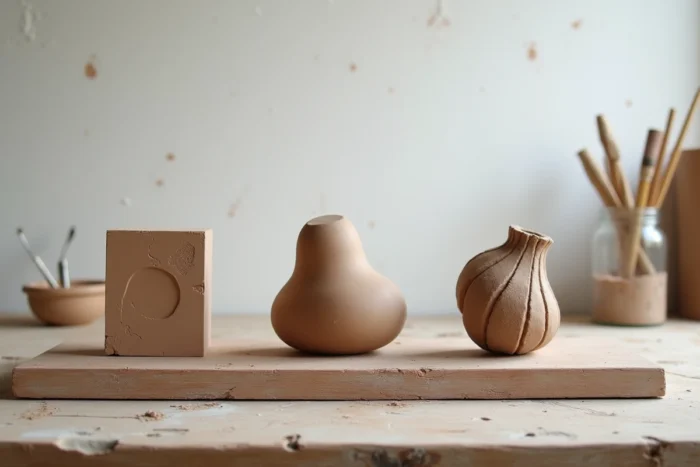
Recent exhibitions of contemporary ceramics show that clay has become a favored experimental ground for abstract works where forms and forces unite to produce highly expressive pieces. This dynamic occurs in a context where the art market simultaneously signals a marked return of figurative art in sales and exhibitions.
This tension is not anecdotal for the practitioner. It influences the expectations of workshops, galleries, and selection juries. A sculptor working in clay abstraction benefits from understanding this positioning: the technical mastery of abstract volumes also nourishes figurative work, since all sculpture, figurative or not, relies on an arrangement of planes, hollows, and masses.
Several contemporary artists also use clay for abstract sculptures that question the body, memory, and power relations, embedding their practice in a reflection on the materiality and vulnerability of the material itself.
Abstract clay sculpture demands no less technical rigor than figurative sculpture. It requires a different form of rigor, focused on the balance of masses, the management of differential drying, and the choice of clay suited to the constraints of each piece. The sculptor who masters pounding with a mallet, hollow construction, and directed drying possesses a formal vocabulary that neither smoothing nor traditional coiling can produce.