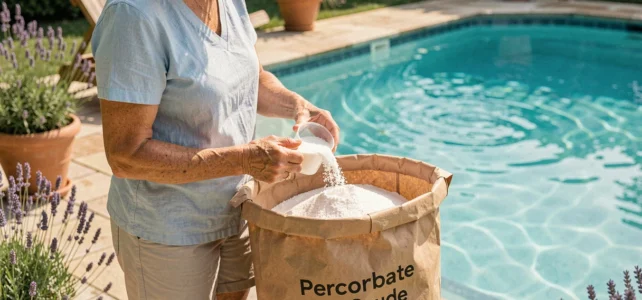
Sodium percarbonate releases active oxygen and sodium carbonate upon contact with water. These two components affect the pH and the organic matter present in a pool. The question arises: how can a product without an official dosage for pool treatment fit into a maintenance protocol without destabilizing the chemical balance of the water?
Sodium percarbonate and pool products: what chemistry distinguishes
Sodium percarbonate (2 Na₂CO₃ · 3 H₂O₂) decomposes into sodium carbonate and hydrogen peroxide as soon as it comes into contact with water. Sodium carbonate raises the pH, while hydrogen peroxide acts as an oxidant, comparable to the active oxygen sold in specialized stores.
The difference with products formulated for pools lies in the concentration and predictability of the reaction. Manufacturers of pH+ or active oxygen calibrate their dosages for precise volumes. Sodium percarbonate is not included in any standard pool treatment protocol, which requires calculating the impact on pH and oxidizing power oneself.
| Product | Main Action | Effect on pH | Standardized Pool Dosage |
|---|---|---|---|
| Sodium carbonate (pH+) | Alkaline correction | Direct increase | Yes, manufacturer tables |
| Active oxygen (peroxide) | Oxidation, anti-algae | Neutral to slightly acidic | Yes, according to pool volume |
| Sodium percarbonate | Oxidation + pH increase | Increase (via released carbonate) | No, empirical use |
This table highlights the central point: sodium percarbonate combines two effects that pool professionals typically manage with two separate products. Mastering the dosage of sodium percarbonate in pools therefore requires simultaneously monitoring the residual disinfectant level and the pH.
Gradual pH correction: why split the inputs
Recent pool treatment guides emphasize a principle of fractional correction: never change the pH by more than 0.2 to 0.4 units per day. This rule applies to pure sodium carbonate, and it applies a fortiori to percarbonate, whose alkaline component is less predictable depending on water temperature and circulation.
A massive addition of percarbonate causes a sharp rise in pH. The water becomes cloudy, whitish, and chlorine loses its effectiveness above a pH of 7.8. Lowering the pH afterward requires pH- (sodium bisulfate or diluted hydrochloric acid), which multiplies chemical interventions and weakens the pool’s balance.
Fractionation method suitable for percarbonate
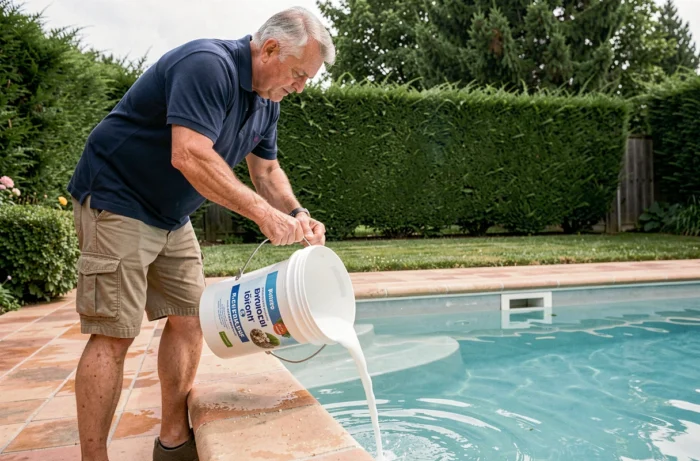
Rather than a single addition, the logic is to divide the estimated amount into several doses spaced a few hours apart, with filtration running. After each addition, a measurement with a tester (strip or photometer) allows checking the pH before proceeding.
- Measure the pH and disinfectant level before any addition, ideally with a photometer to limit reading errors.
- Dissolve a small amount of percarbonate in a bucket of warm water before pouring it in front of the return jets, with filtration activated.
- Wait several hours, then retest the pH. If the difference remains less than 0.4 units from the target, a second addition may be considered.
- Stop additions as soon as the pH reaches the range of 7.2-7.4, even if the initially planned amount has not been fully used.
Overdosage is the main risk with percarbonate in pools. The whitish water reported by some users almost always results from a too concentrated addition all at once.
Percarbonate against green algae: real effectiveness and limits
The active oxygen released by percarbonate has an oxidizing power that destroys some of the suspended algae. At the onset of greening (slightly tinted water, slippery walls), a shock treatment with active oxygen may be sufficient to restore clear water.
However, in the case of advanced proliferation (opaque water, invisible bottom), percarbonate alone does not replace a shock treatment with chlorine. Hydrogen peroxide degrades quickly under UV light, and its residual effect is too weak to eliminate an established carpet of algae. The sodium carbonate released simultaneously raises the pH, which paradoxically promotes algae growth if the correction is not immediate.
When percarbonate is beneficial against algae
Its use is justified in two specific cases. The first: a pool usually treated with active oxygen, where percarbonate serves as an occasional supplement. The second: a light correction at the beginning of the season, when the water has a green veil without massive proliferation, and the pH is low (below 7.0). In this scenario, the pH increase caused by sodium carbonate is a useful side effect rather than a problem.
Filtration and pool maintenance after treatment with percarbonate
The addition of percarbonate generates suspended residues, especially when it has not been pre-dissolved. These particles saturate the filter more quickly than a liquid product. A backwash of the filter in the hours following the treatment limits clogging and improves water clarity.
Filtration must run continuously throughout the correction phase (at least several hours). Stopping the pump after an addition of percarbonate means allowing the product to concentrate locally, with a risk of whitish deposits on the liner or coping.
Points of caution for sensitive surfaces
Percarbonate is alkaline. On a clear liner, white marks usually disappear with circulation. On a dark coating or mineral plaster, prolonged contact with a concentrated solution may leave more stubborn marks. Pre-dissolving the product and pouring it away from the walls remains the simplest precaution.
Sodium percarbonate offers a one-time alternative to conventional products, provided that a fractional protocol is followed and the pH is monitored after each addition. Its lack of standardized dosage for pools requires a higher level of measurement rigor than dedicated products. For regular maintenance, it remains a supplement, not a substitute for the main pool treatment.