
Eurostar and TGV INOUI both operate at high speed on the European rail network, but they are subject to different pricing rules, refund policies, and border constraints. Before booking a ticket to connect Paris with London, Brussels, or a French city, comparing these two services based on concrete criteria helps avoid unpleasant surprises, from unexpected passport checks to compensation rights in case of delays.
Compensation for delays: Eurostar and TGV INOUI have distinct approaches
| Criterion | Eurostar | TGV INOUI |
|---|---|---|
| Trigger threshold | 60 minutes delay | 30 minutes (MAX fares) |
| Compensation for 60-119 min | 25% of the ticket price | Variable depending on the fare |
| Compensation for 120 min and more | 50% of the ticket price | Variable depending on the fare |
| Form of compensation (vouchers) | Refund or travel voucher | 5 euro voucher from 30 min (MAX) |
| Formalities | Passport required | ID card (France routes) |
The trigger thresholds create a notable gap for regular travelers. A TGV INOUI MAX subscriber receives compensation from 30 minutes of delay, while Eurostar does not provide anything until a full hour has passed.
On the other hand, for a delay of two hours or more, Eurostar refunds half of the ticket price. On an international journey charged at a high fare, this amount far exceeds a voucher of a few euros.
To delve deeper into the match between Eurostar and TGV, the differences in onboard service and pricing also deserve close examination.

Network and destinations: Eurostar and TGV INOUI on complementary routes
Eurostar operates on international routes departing from Paris Gare du Nord or Lille Europe, with services to London, Brussels, and Amsterdam. The consolidation of former brands under one operator has expanded this scope.
TGV INOUI covers the French domestic network and a few cross-border destinations. The two services do not replace each other; they occupy distinct geographical axes.
Border crossing formalities
A TGV INOUI traveling within France or to Switzerland only requires an ID card. For Eurostar to London, a passport remains mandatory, and the UK’s ETA (Electronic Travel Authorisation) system will apply to affected travelers.
This requirement necessitates arriving at the station well before departure to pass through security and immigration checks. The total travel time is significantly extended compared to a domestic TGV journey.
Fares and travel classes: what affects ticket prices
Both operators practice yield management, but the price ranges and included services differ significantly, even on comparable routes.
- Eurostar offers three levels (Standard, Plus, Premier) with marked differences in services between the first and last tiers, particularly regarding access to dedicated areas at the station and catering.
- TGV INOUI operates in two classes (Second and First), with Prem’s fares available several weeks before departure. First class offers more space and an individual power outlet, without served catering.
On both services, two pieces of luggage are allowed at no extra charge. Compared to air travel, where baggage allowances increase costs, this is a direct advantage.
The price of a Eurostar Standard ticket to London varies greatly depending on the purchase date. Booking several weeks in advance brings the fare closer to that of a long-distance TGV INOUI. Conversely, a last-minute ticket on Eurostar can exceed the cost of an equivalent flight.
Punctuality and resilience to weather disruptions
Heatwaves disrupt both networks, but through different mechanisms. French high-speed lines impose speed restrictions during periods of extreme heat, which slows down TGV INOUI services. The Channel Tunnel generates its own operational constraints for Eurostar.
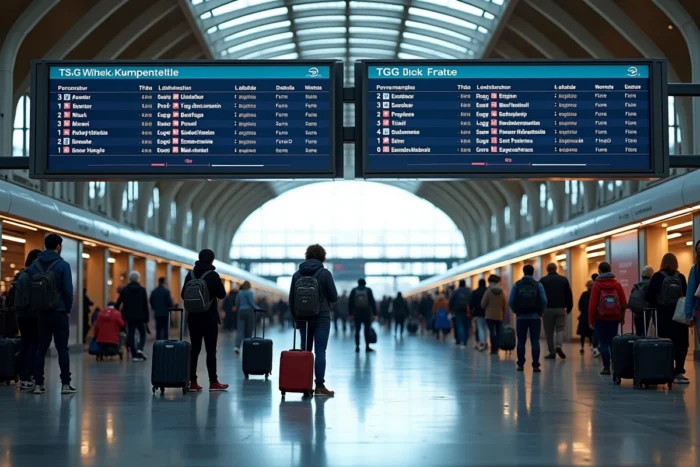
The density of the domestic network works in favor of TGV INOUI: in case of disruption, there are more replacement options. A traveler booking Eurostar in the height of summer for a tight connection with a flight or a time-sensitive event faces a higher risk.
Rolling stock renewal: a long-term reliability factor
The approval procedures for new trains in France are under discussion to expedite the renewal of rolling stock. If this process succeeds, it could improve reliability and comfort on the domestic TGV INOUI network in the coming years.
The choice between Eurostar and TGV INOUI boils down to three concrete variables: the destination (international or domestic), sensitivity to the risk of delays with the associated compensation rights, and the actual budget once ancillary costs are included. On a Paris-Brussels route, the two operators are in direct competition, and the difference lies in the fare, ticket flexibility, and refund policy rather than travel time.