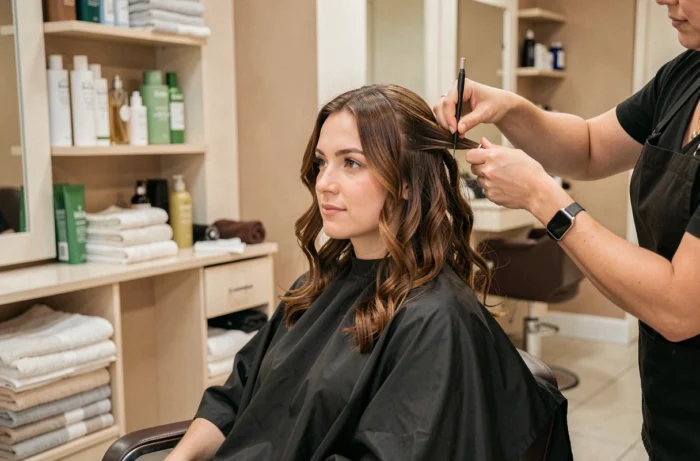
The ammonia-free perm is generating increasing interest among people who want to curl or wave their hair without resorting to the most aggressive formulations. The promise seems simple: achieve long-lasting hold while preserving the hair fiber. The challenge remains to measure what the label “ammonia-free” truly entails and what it technically changes for the health of the hair.
Monoethanolamine vs. ammonia: what formulations really change
Removing ammonia from a perm or coloring formula does not eliminate the need for an alkaline agent. To swell the cuticle and allow for the restructuring of disulfide bonds (in the case of a perm) or the penetration of pigments (in the case of coloring), an alkalizing agent is still necessary.
Monoethanolamine (MEA) is the most common alternative. Less volatile than ammonia, it does not emit the characteristic smell that can be bothersome in salons. However, its lower volatility means it can remain in contact with the hair fiber for a longer time, raising a rarely discussed question: the benefit is often more sensory than structural.
| Criterion | Ammonia | Monoethanolamine (MEA) |
|---|---|---|
| Volatility | High (strong smell, quick evaporation) | Low (subtle smell, prolonged contact) |
| Cuticle opening | Fast and marked | Progressive, potentially prolonged |
| Sensation during application | Frequent olfactory irritation | Superior comfort |
| Impact on the fiber | Known and documented alteration | Alteration present, less studied in the long term |
| Regulatory status | Allowed with restrictions | Allowed, considered milder |
This table highlights a often overlooked point: an ammonia-free formulation remains an oxidative formulation. The underlying chemical mechanism – alkalization, cuticle opening, internal modification – remains comparable. For those who wish to learn more about Miss Marion, the topic is detailed from the perspective of concrete alternatives.
Ammonia-free perm and curl hold: a real performance gap
The hold of a perm depends on the depth of the restructuring of disulfide bonds in the hair cortex. The more effectively the alkaline agent penetrates, the more stable the new shape (curl or wave) is over time.
With ammonia, the cuticle opens sharply and quickly. Reducing agents access the cortex uniformly. The classic perm generally offers longer hold and a more predictable result on thick or resistant hair.
In contrast, formulations based on MEA or other mild alkalizing agents produce a more gradual opening of the cuticle. The result tends towards softer, less defined waves, with a hold duration often shorter. On fine or already sensitized hair, this gentler approach may suffice. On thick hair, the result may disappoint in terms of definition.
Gray hair and ammonia-free perm
Gray hair has a modified texture: the cuticle is often thicker, and the cortex is less dense in melanin. These characteristics make the penetration of reducing agents more delicate. Gray hair is more resistant to mild formulas, which may require a longer application time or a suitable choice of rollers.
New ammonia-free technologies: the case of metal neutralization
Research in hair cosmetics is no longer limited to replacing ammonia. A recent avenue targets metals accumulated in the hair fiber (copper, iron), which amplify oxidative stress during chemical treatments.
The Metal Purifier technology, integrated into the Wella Pure Perfection line launched in September 2026, illustrates this approach. The product is presented as free from ammonia, fragrance, mineral oil, silicones, and PPD/PTD. The announced results – more shine, softness, and nourished appearance – come from a brand clinical study.
This distinction is important: it is not an independent comparison with all classic colorations. The available data do not allow for a conclusion of absolute superiority across all criteria. They indicate a direction of formulation that seeks to reduce cumulative aggressions on the fiber.
What this approach changes for the perm
If metal neutralization effectively reduces oxidative stress during a chemical treatment, the benefit could extend to ammonia-free perms. Hair less weakened by residual metals would tolerate the restructuring of disulfide bonds better, even with a mild alkalizing agent. This hypothesis remains to be confirmed by independent studies.
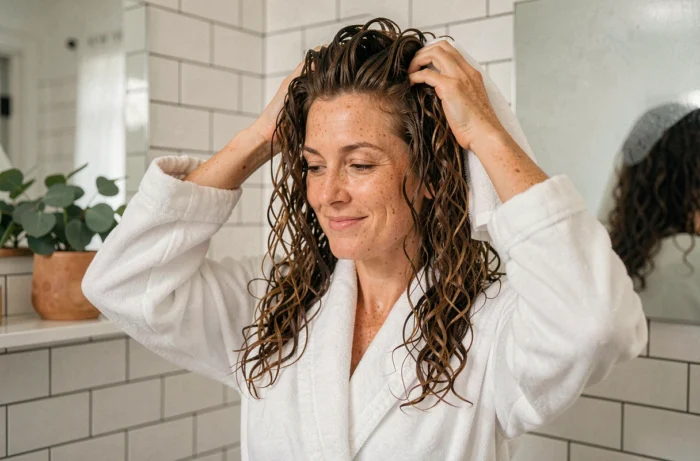
Natural solutions for waving hair: what works and what is marketing
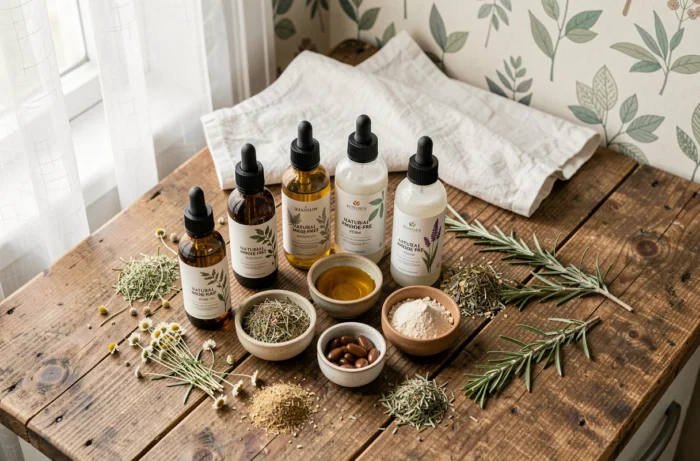
The term “natural perm” encompasses very different realities. Some formulations incorporate plant-based active ingredients (aloe vera, bamboo, wheat proteins) into a chemically active base. Others offer mechanical techniques without chemical products.
- Formulations enriched with plant-based actives (aloe vera for hydration, bamboo for flexibility) improve care during and after the treatment but do not replace the alkaline agent necessary for restructuring
- Heat-free styling techniques (foam rollers, braids, rollers) create temporary waves without any chemical modification of the fiber
- Texturizing sprays based on sea salt or sugars add volume and a wavy texture, with an effect that disappears after the next shampoo
None of these alternatives produce a permanent curl comparable to a chemical treatment. The choice is between durability of the result and total absence of alkaline product. Any durable curl involves a chemical modification of keratin, regardless of the product label.
The measurable difference between a perm with and without ammonia is more about application comfort and sensory preservation than a fundamental break in mechanism. For hair already weakened or a reactive scalp, ammonia-free formulations reduce immediate aggression. For a lasting result on resistant hair, the question of the effectiveness of the alkalizing product remains crucial, regardless of its name on the label.